
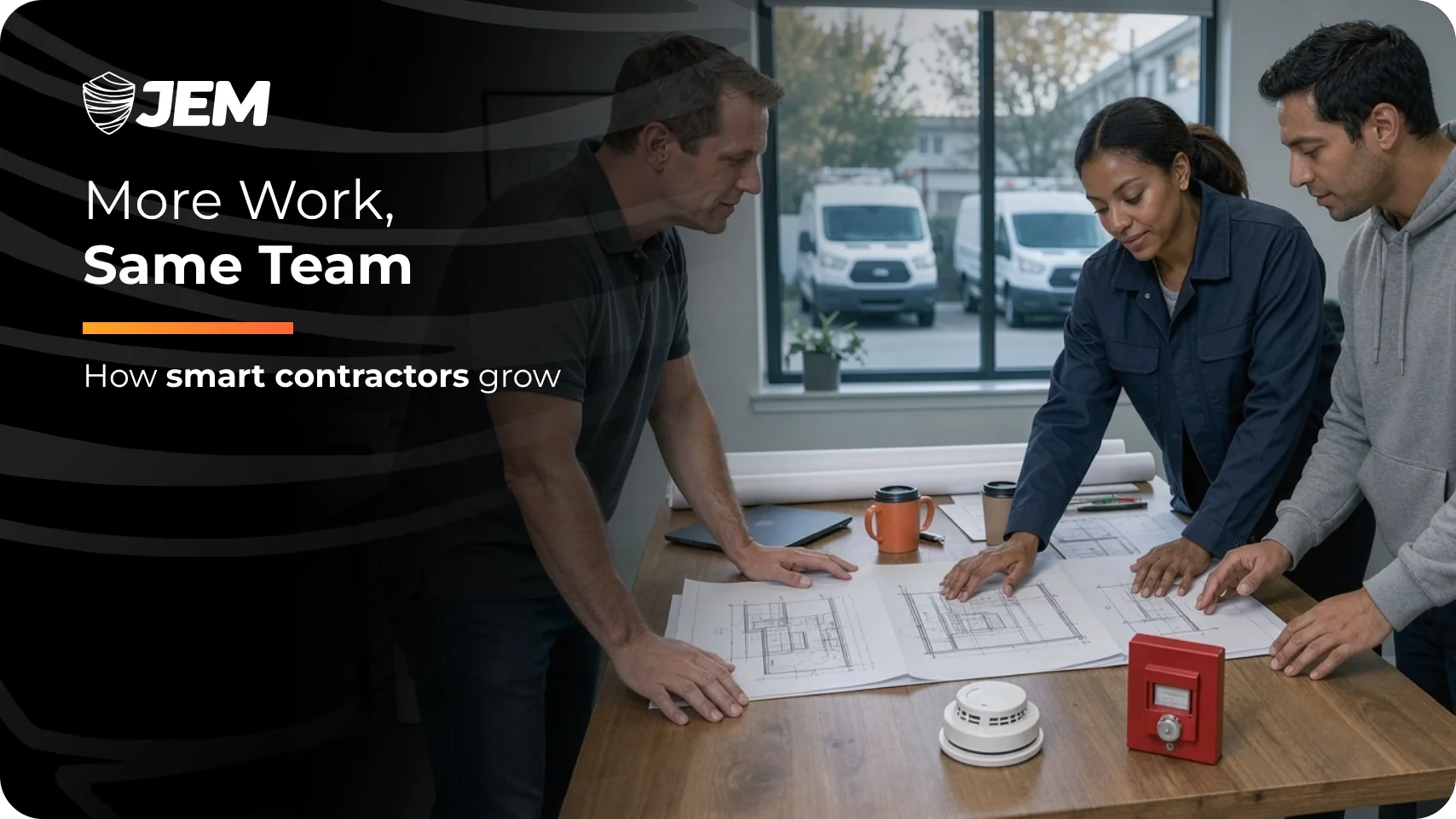
Growing a fire and life safety business used to mean one thing: hire more people. However, today that is the hardest lever to pull. Skilled workers are scarce, jobs are more complex, and owners want more systems from one partner. Below are five practical levers for scaling without burning out your team, with recent industry data, as of November 2026.
Key takeaways
- Demand is there: over 40% of security and fire companies surveyed by SDM expected fire alarm revenue to grow in 2026.
- People are the limit: 53% of skilled trades workers in NFPA’s 2026 survey named the shortage of qualified candidates as their top challenge.
- Coordination is a hidden cost: miscommunication and scheduling top technicians’ list of frustrations.
- Scale with leverage: outside design support, new service lines and better processes add capacity without adding headcount.
Where the fire and life safety business stands
The market signals are positive. In the SDM 2026 Industry Forecast, over 40% of respondents expected fire alarm revenue to increase in 2026. Also, fire work is spreading across the security channel. In an earlier SDM survey, 60% of companies said they already offer, sell or install fire alarm products.
However, growth runs into a wall: people. In NFPA’s survey for 2026, 53% of skilled trades workers named the shortage of qualified candidates as their biggest challenge. In addition, 39% cited retention, as reported by the International Fire & Safety Journal.
Lever 1: move design hours off the field team
First of all, look at where your best people spend their week.
Often, design, takeoff and submittals eat hours your top techs could spend on site. So, one of the fastest ways to scale is to hand part of that work to a design partner. That way, your field leads stay in the field, and the paperwork still gets done.
Lever 2: add service lines to your fire and life safety business
After all, many owners need more than a fire alarm. For example, buildings may also need in-building radio coverage (BDA/DAS/ERCES), sprinkler design or early detection. So, adding one of these lets you sell more to the same customer. Still, each line has its own rules, so plan the training first. Our article on BDA services covers what to check.
Lever 3: coordinate earlier with BIM
Above all, complex projects reward early coordination. As Consulting-Specifying Engineer noted, BIM helps designers avoid conflicts with other trades before a system is installed. In other words, fewer surprises in the ceiling mean fewer return trips.
Lever 4: fix the friction your team feels
Of course, pay matters, but it is not the only driver. In ServiceTrade’s 2026 Technician Insights Report, miscommunication (45%) and inefficient scheduling (44%) topped the list of technician frustrations. In fact, both are process problems. As a result, a clear job packet and a steady schedule can keep good people longer.
Lever 5: standardize to grow a fire and life safety business
Scaling means doing the same thing well, many times. For that reason, write down how your company handles the basics:
- A single submittal format for every AHJ you work with.
- Labels: one standard for devices, circuits and panels.
- A checklist before every acceptance test.
- Handover: the same package for every owner.
Then, train new hires on those standards from day one.
How JEM grew alongside its customers
Similarly, JEM’s own story follows the path of a growing fire and life safety business. According to its About page, JEM began in 2019 as JEM Security and grew into JEM Systems. Now, the page lists a team of over 200 engineers and more than 20,000 projects delivered. Its services include fire alarm, BDA/ERCES, BIM, PCTEL testing, sprinkler design and early detection.
What scaling means for your business
In the end, you do not have to grow by headcount alone. A fire and life safety business can add capacity through partners, new lines and better habits. In practice:
- Measure where hours go and move the easiest ones first.
- Add one service line at a time, with training in place.
- Coordinate early on complex jobs.
- Standardize before you scale.
To see the full list of support options, visit JEM’s services page. For design help on your next job, the Fire Alarm Design team offers a quote in 18 hours.
Frequently asked questions
What is the fastest way to add capacity?
Often, it is moving design and paperwork hours off your field team, through a partner or a better process.
Should a fire alarm company add BDA/DAS/ERCES work?
It can be a good fit, since the customers overlap. Check local rules and training needs first.
Does BIM help smaller projects?
It helps most on complex jobs with tight ceilings and many trades. On simple jobs, a clean 2D design may be enough.
This article is general information and does not replace the requirements of your jurisdiction. Confirm the applicable codes with your AHJ.
Read next: Looking Back at CAFAA 2026: JEM Systems as Gold Sponsor
Sources
- SDM 2026 Industry Forecast, SDM Magazine (January 5, 2026)
- State of the Market: The Impact of New Technology on Fire and Life Safety, SDM Magazine (October 20, 2025)
- NFPA Skilled Trades survey shows technology plans and workforce worries, International Fire & Safety Journal (January 15, 2026)
- Coordinating fire protection designs via BIM, Consulting-Specifying Engineer (April 18, 2017)
- 2026 Technician Insights Report, ServiceTrade (February 11, 2026)

Leave a Reply