
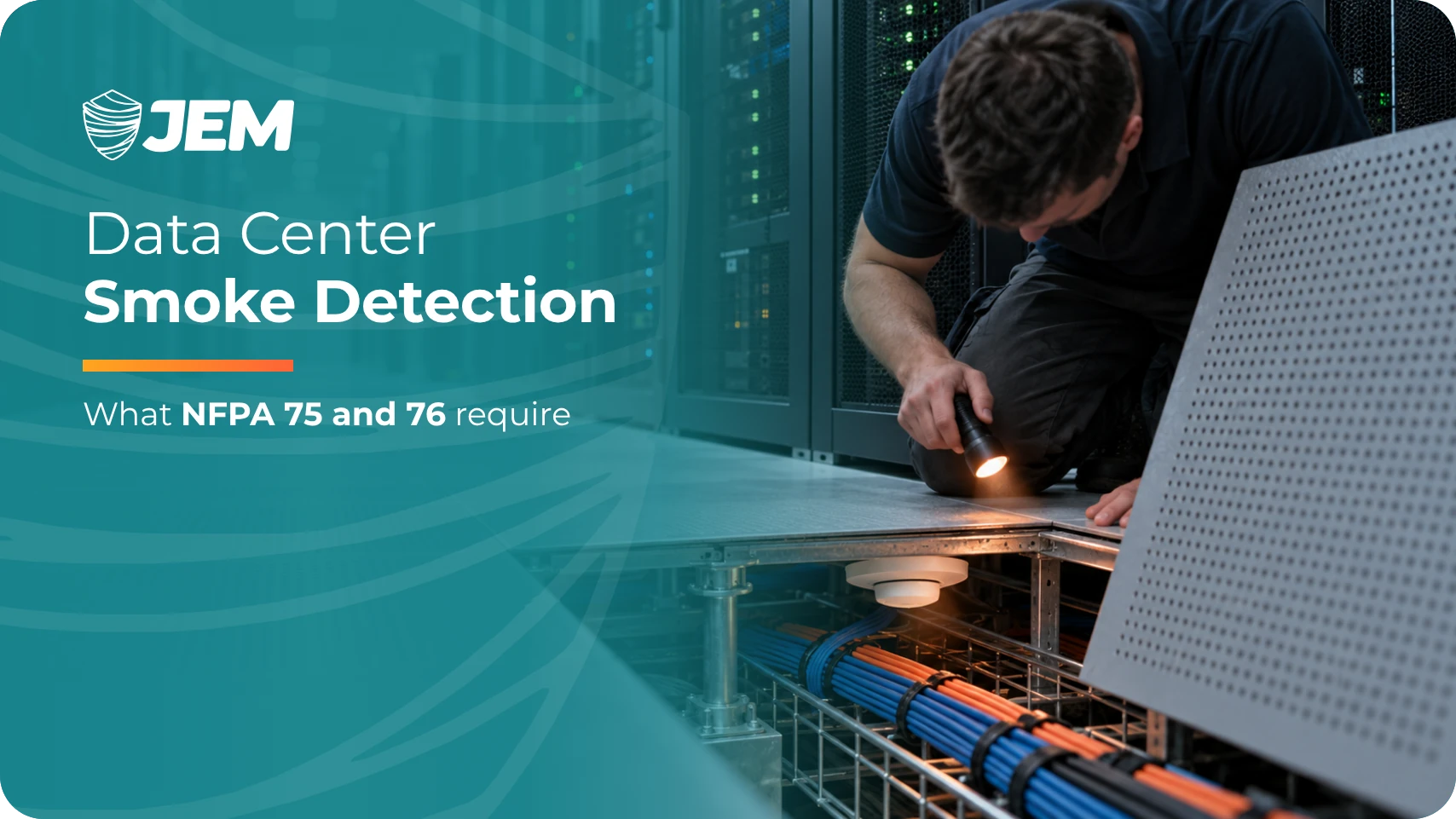
In a data center, a small fire can do outsized damage. Smoke and heat can harm equipment, and the downtime that follows can cost far more than the fire itself. That is why data center smoke detection is a design decision, not an afterthought. Below is what the key NFPA standards say, where detectors need to go and how aspirating systems fit in, as of November 2026.
Key takeaways
- NFPA 75 covers IT equipment areas; its current edition is 2024.
- Detection goes in more than one place: at the ceiling, below raised floors with cables and in return air plenums.
- NFPA 76 covers telecom facilities and sets detection levels, including very early warning.
- Aspirating systems are one option, and their performance depends on design and maintenance.
Why data center smoke detection matters
To begin with, data centers pack a lot of power and cable into tight spaces. Also, cooling systems move large volumes of air, which can dilute smoke and carry it away from ceiling detectors. As a result, smoke can be harder to catch early than in a typical office.
So, good data center smoke detection has two goals. First, it should catch a fire early enough to protect life and equipment. Second, it should give the operator time to act before a small problem becomes an outage.
The standards behind data center smoke detection
In the U.S., two NFPA standards do most of the work here.
First, NFPA 75, the Standard for the Fire Protection of Information Technology Equipment, has a 2024 edition. Per its ANSI listing, it sets the minimum rules to protect IT equipment and IT areas.
Second, NFPA 76 covers the fire protection of telecom facilities, and it also has a 2024 edition. Its scope includes equipment areas, power and battery areas and cable entrance spaces.
In both cases, data center smoke detection still follows NFPA 72 for how you install and maintain the system.
Where NFPA 75 calls for detection
Notably, NFPA 75 is specific about location. Its Section 9.2.2 calls for automatic detection to give early warning of fire in places such as the ones below. This comes from the current text, as shown in NFPA’s public input report for the next edition:
- At the ceiling level throughout the ITE area.
- Below the raised floor of the ITE area when it contains cables.
- In the return air stream when the space above the ceiling is a return air plenum.
In addition, Section 9.2.3.1.1 refers to a listed smoke detection type system installed and maintained under NFPA 72. Since the report reflects a draft cycle, confirm the wording in the edition your AHJ enforces.
Raised floors and plenums are easy to miss
Of course, spaces under floors and above ceilings are out of sight. Yet they can hold a lot of cable. Therefore, plan detection there from the start, along with access for testing.
NFPA 76 and very early warning
Telecom facilities add another layer. As Shane Clary explained in Security Sales & Integration in 2019, citing the 2016 edition, NFPA 76 uses three detection levels: very early warning fire detection (VEWFD), early warning fire detection (EWFD) and standard fire detection (SFD). He also noted that NFPA 76 sets minimum sensitivity and spacing for these systems.
Also, for more on very early warning, read our article on early detection in data centers.
Aspirating systems for data center smoke detection
Meanwhile, aspirating smoke detectors draw air through a pipe network to a central detector. For standard fire detection, a System Sensor applications guide says the maximum transport time from the most remote hole to the detector cannot exceed 120 seconds. In other words, pipe design matters as much as the detector.
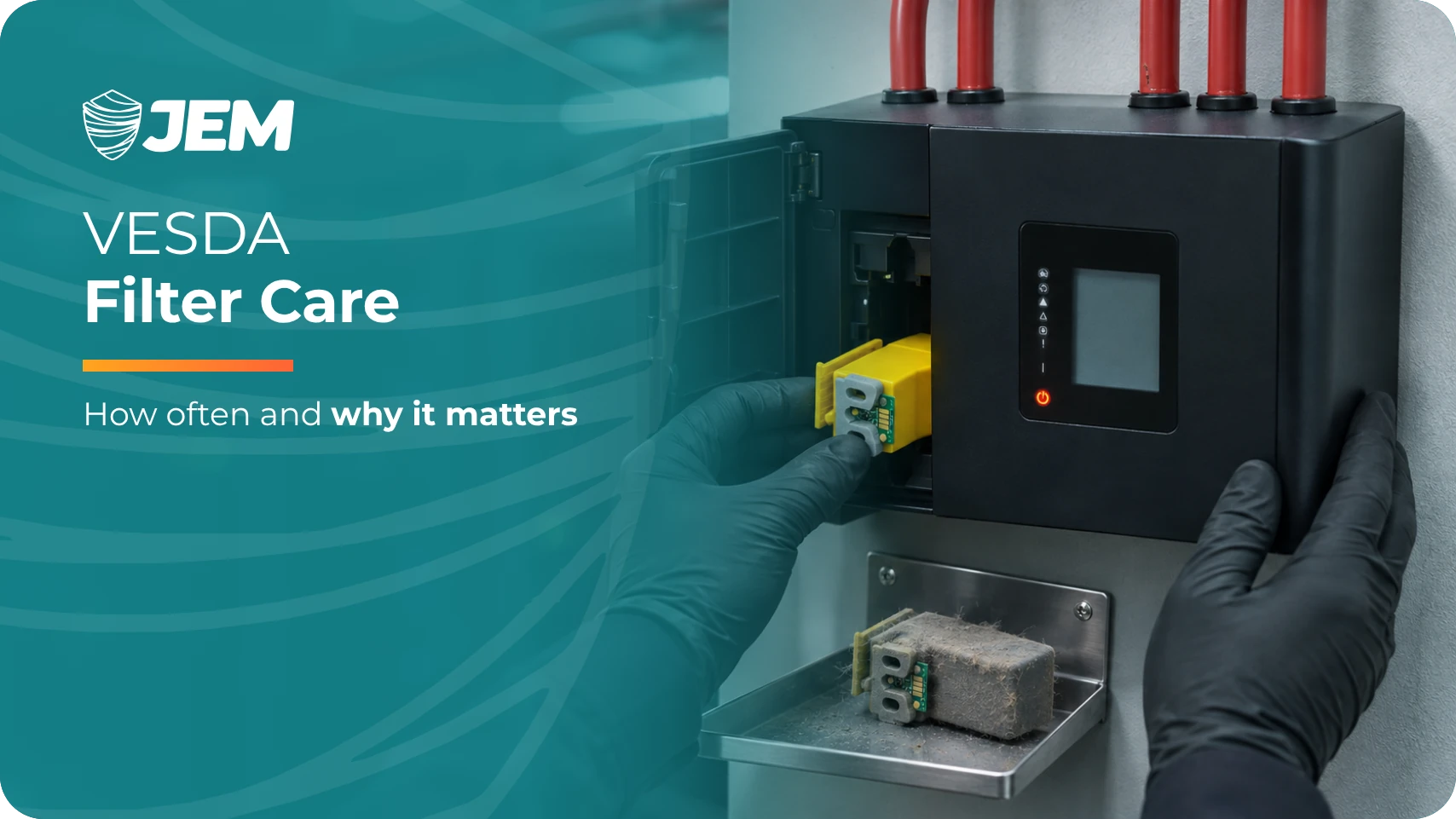
Upkeep matters too. For example, VESDA filters need to be swapped on a schedule set by the site, as our VESDA filter article explains.
What this means for contractors
Overall, data center work rewards careful design and clean records. In practice:
- Check NFPA 75 and NFPA 76 for the project’s space types.
- Cover every level: ceiling, under floor and plenum.
- Design pipe runs for transport time.
- Plan maintenance before handover.
For aspirating projects in particular, JEM’s Early Detection team provides pipe layouts, flow calculations, a bill of materials and complete submittal packages. For conventional and addressable systems, see JEM’s Fire Alarm Design service.
Frequently asked questions
Which NFPA standard covers data centers?
NFPA 75 covers IT equipment and IT areas. Meanwhile, NFPA 76 covers telecom facilities.
Where does NFPA 75 require smoke detection?
At the ceiling level throughout the ITE area, below raised floors with cables and in return air plenums, among other places.
What is VEWFD?
It stands for very early warning fire detection. In short, it is one of the detection levels in NFPA 76.
This article is general information and does not replace the requirements of your jurisdiction. Confirm the applicable codes with your AHJ.
Read next: JEM Is Now Part of the Honeywell Ignite Program
Sources
- NFPA 75, 2024 edition, listing
- ANSI Webstore listing for NFPA 75-2024
- NFPA 75 public input report, next edition cycle, NFPA
- NFPA 76, 2024 edition, listing
- Fire protection standards for telecom facilities, Shane Clary, Security Sales & Integration (May 29, 2019)
- Aspirating Smoke Detection Applications Guide, System Sensor
Leave a Reply