
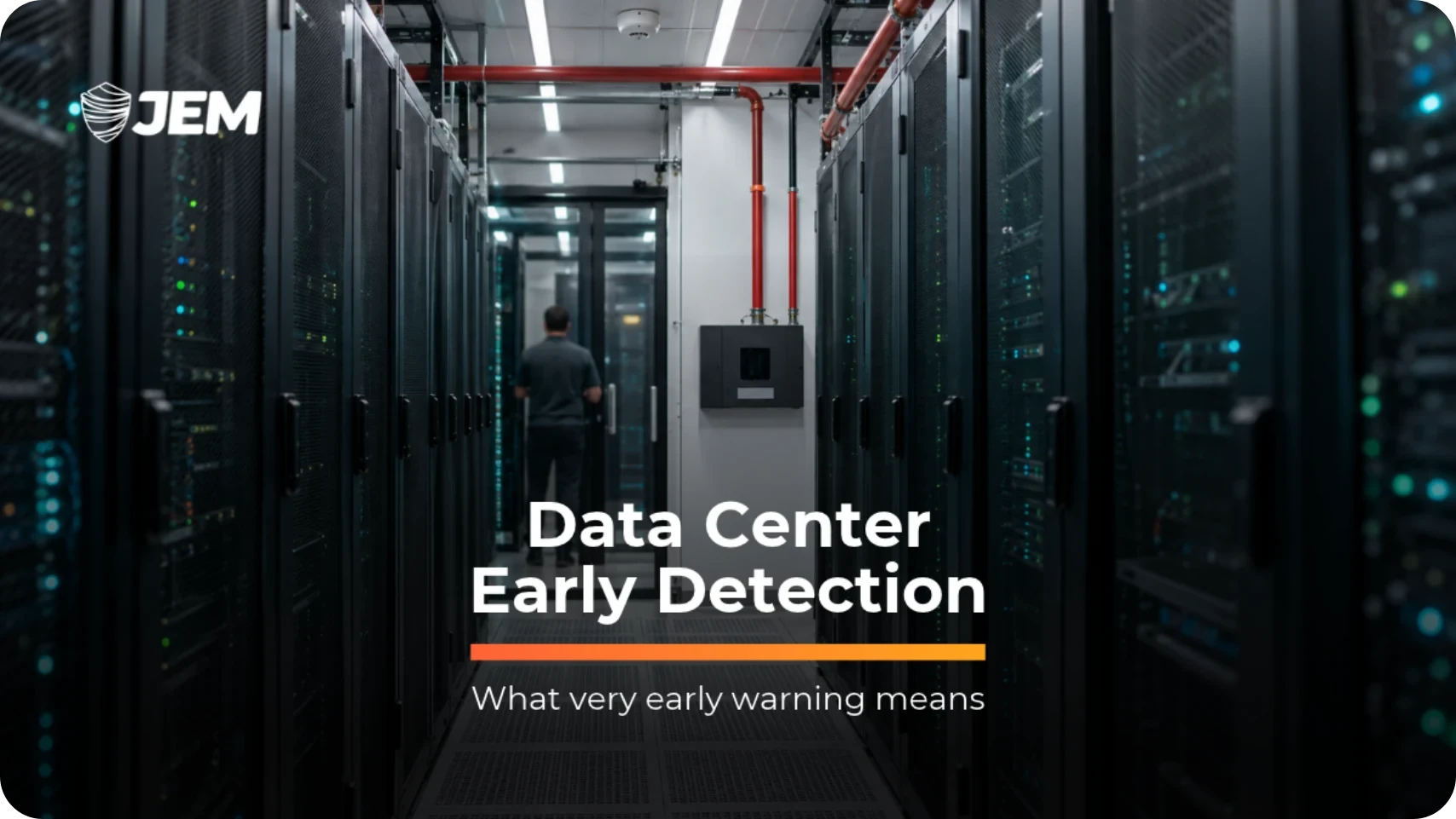
Data center early detection aims to catch a fire at its first trace, well before smoke reaches a ceiling detector. In practice, that usually means aspirating smoke detection, which pulls air through small pipes and checks it nonstop. Johnson Controls calls very early warning a must now that data halls run hotter and denser. Below is what the term means, why airflow matters, how lithium-ion UPS rooms change the plan, and what to ask your designer, as of November 2026.
Key takeaways
- How it works: an aspirating system pulls air from the room through small pipes to a central detector, so it does not wait for smoke to drift to a spot device.
- Why data halls use it: Johnson Controls calls aspirated detection ideal for high-airflow spaces that need very early warning.
- Lithium-ion UPS rooms: prevention comes first, with early warning and off-gas monitoring, because thermal runaway cannot be stopped once it starts.
- Above the minimum: codes protect the building and the people inside. Very early warning is often a layer owners add to protect uptime.
What “very early warning” means in data center early detection
A spot smoke detector reacts when enough smoke reaches it. In many buildings, that is early enough. A data hall is different, though, because the equipment runs hot, the racks sit close together, and the air never stops moving.
Very early warning tries to sense a fire while it is still small and smoldering. As Johnson Controls puts it in its March 2026 data center guide, smoke-activated systems act early in this first stage, while heat-activated systems react later. So, the earlier the signal, the more time the team has to find the source and act.
How aspirating smoke detection works
An aspirating system draws air from the protected space through a network of small, perforated pipes. The samples travel back to a central detector, which checks the air all the time. In other words, the system goes looking for smoke instead of waiting for it.
Many systems also give staged alarms. For example, a Johnson Controls piece in International Fire & Safety Journal names two steps. First comes an alarm when smoldering particles rise. Then a second alarm flags smoke.
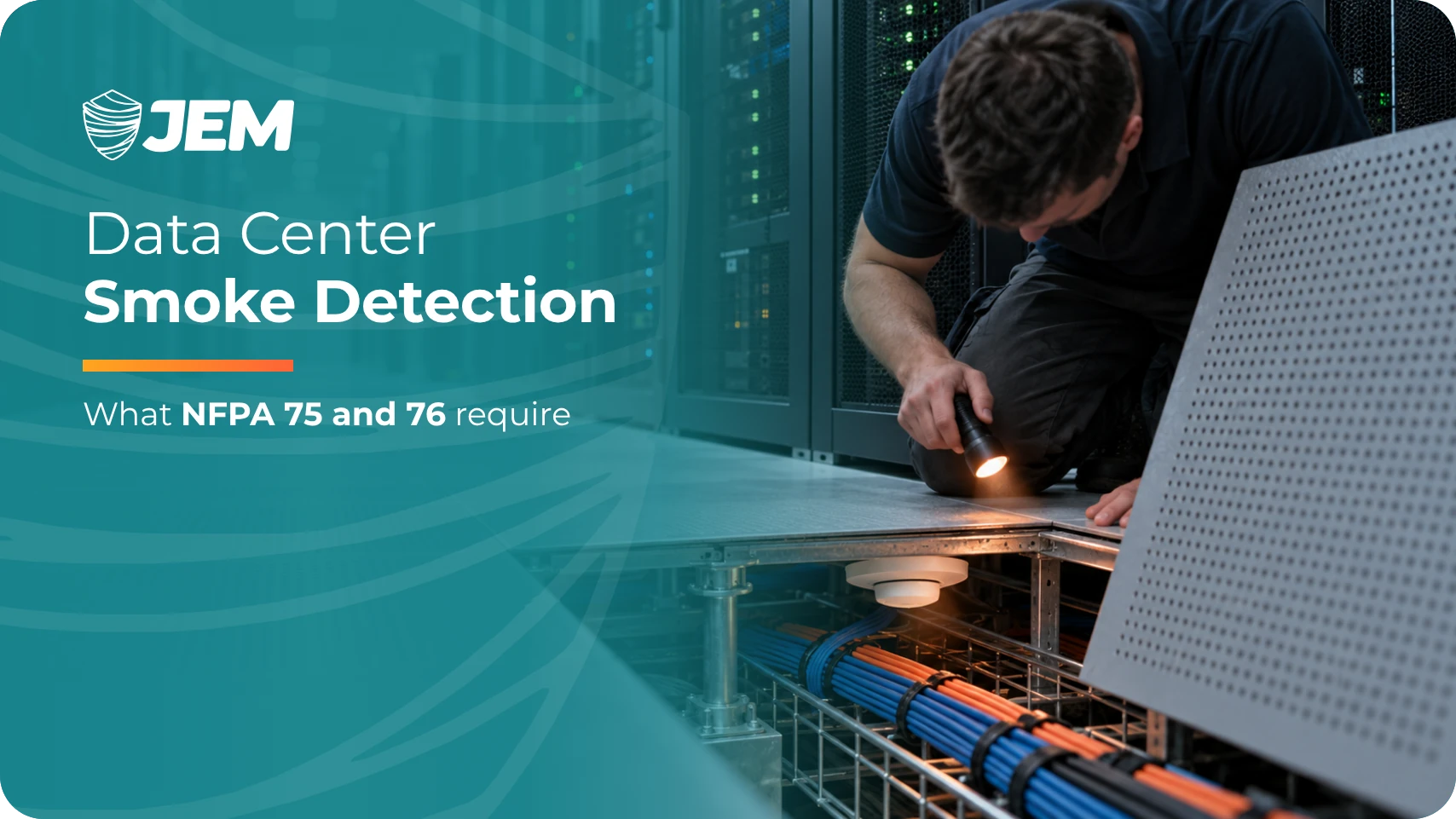
Placement still matters, however. Johnson Controls notes that aisle containment and underfloor spaces must be part of the layout. It also points to multi-criteria sensing, which uses smoke, heat and CO data to confirm true events and cut false alarms.
Why data halls ask for early detection
Airflow is the detail that matters most. Data halls move air all day to cool the servers. In a room like that, smoke can spread out and thin before a ceiling device sees it. That is why Johnson Controls lists aspirated detection as ideal for high-airflow spaces that need very early warning.
Density is the other driver. According to the same guide, today’s data halls are hotter, tighter and more complex. What was once a single computer room is now a maze of separate airflow zones, each one adding heat. As a result, data center early detection has to keep pace with the heat.
Lithium-ion UPS rooms need a prevention-first plan
Lithium-ion batteries add a new worry. Johnson Controls says lithium-ion UPS (uninterruptible power supply) systems bring their own risk: thermal runaway, which cannot be stopped once it starts. Its guidance lists four steps:
- Put prevention first: early warning and off-gas monitoring are a must.
- Keep them apart: where you can, put large battery arrays in separate buildings or against outside walls.
- Limit spread: gaseous agents or water-based systems can control the room, but they cannot halt thermal runaway inside the cells.
- Talk early: work with insurers and AHJs on venting, alarm levels and emergency plans.
Here, data center early detection buys time to act. It does not replace prevention. For lead-acid battery rooms, Johnson Controls points to hydrogen detection instead.
Is data center early detection required by code?
In most cases, very early warning is a design choice, not a blanket rule. Johnson Controls explains why in its FAQ. Codes focus on the building and the people inside. Data centers, on the other hand, also need to keep running and protect costly gear. That can mean extra layers above the code minimum.
Even so, the rules depend on the space. NFPA 75 covers fire protection for IT equipment. Meanwhile, NFPA 76 covers telecom sites. Both are in their 2024 editions as of November 2026. Which one applies, and which edition your jurisdiction enforces, is a question for the authority having jurisdiction (AHJ) and the owner’s insurer.
Three questions to ask your designer
- What are we protecting, and what would a fire or an outage cost? Johnson Controls starts with a risk review of protected areas, response time, asset value and downtime tolerance.
- How early do we need to know? The answer drives the detection type, the alarm stages and where the sampling holes go.
- How will the system tie into the fire alarm panel? Aspirating detection still has to report, start the right sequence and fit the suppression plan.
Need a design? JEM’s Early Detection service covers the pipe layout and flow calculations. It also includes a full bill of materials, CAD drawings and a complete submittal package.
What this means for contractors
Data center early detection starts as an owner choice, but it lands on your drawings. In practice, a few habits help on every critical space:
- Ask about uptime early, and write the detection goal into the design basis.
- Walk the airflow. Containment, underfloor spaces and high air movement all change where samples should be taken.
- Treat lithium-ion UPS rooms as their own risk, with off-gas monitoring and early AHJ coordination.
- Confirm the standard and edition with the AHJ before you price the job.
Related at JEM: find aspirating lines such as VESDA and ModuLaser in the JEM catalog.
Frequently asked questions
What is aspirating smoke detection?
It is a method that draws air through a pipe network to a central detector and analyzes it continuously, instead of waiting for smoke to reach a ceiling device.
Why do data centers use very early warning detection?
Data halls run hot and dense and move a lot of air. For that reason, Johnson Controls calls aspirated detection ideal for high-airflow spaces that need very early warning.
Does early detection stop a lithium-ion battery fire?
No. It gives the team time to act. Johnson Controls says thermal runaway cannot be stopped once it starts, so prevention and off-gas monitoring come first.
Planning a critical space? Talk to the JEM Early Detection team.
This article is general information and does not replace the requirements of your jurisdiction. Confirm the applicable codes with your AHJ.
Read next: ERCES Codes in 2026: What California and Georgia Adopted
Sources
- Fire protection of data centers: Balancing economics, environment and uptime, Johnson Controls (March 18, 2026)
- Safeguarding data centres with Johnson Controls’ early detection, International Fire & Safety Journal (October 10, 2025)
- NFPA 75, Standard for the Fire Protection of Information Technology Equipment, NFPA (current edition: 2024)
- NFPA 76, Standard for the Fire Protection of Telecommunications Facilities, NFPA (current edition: 2024)
Leave a Reply