
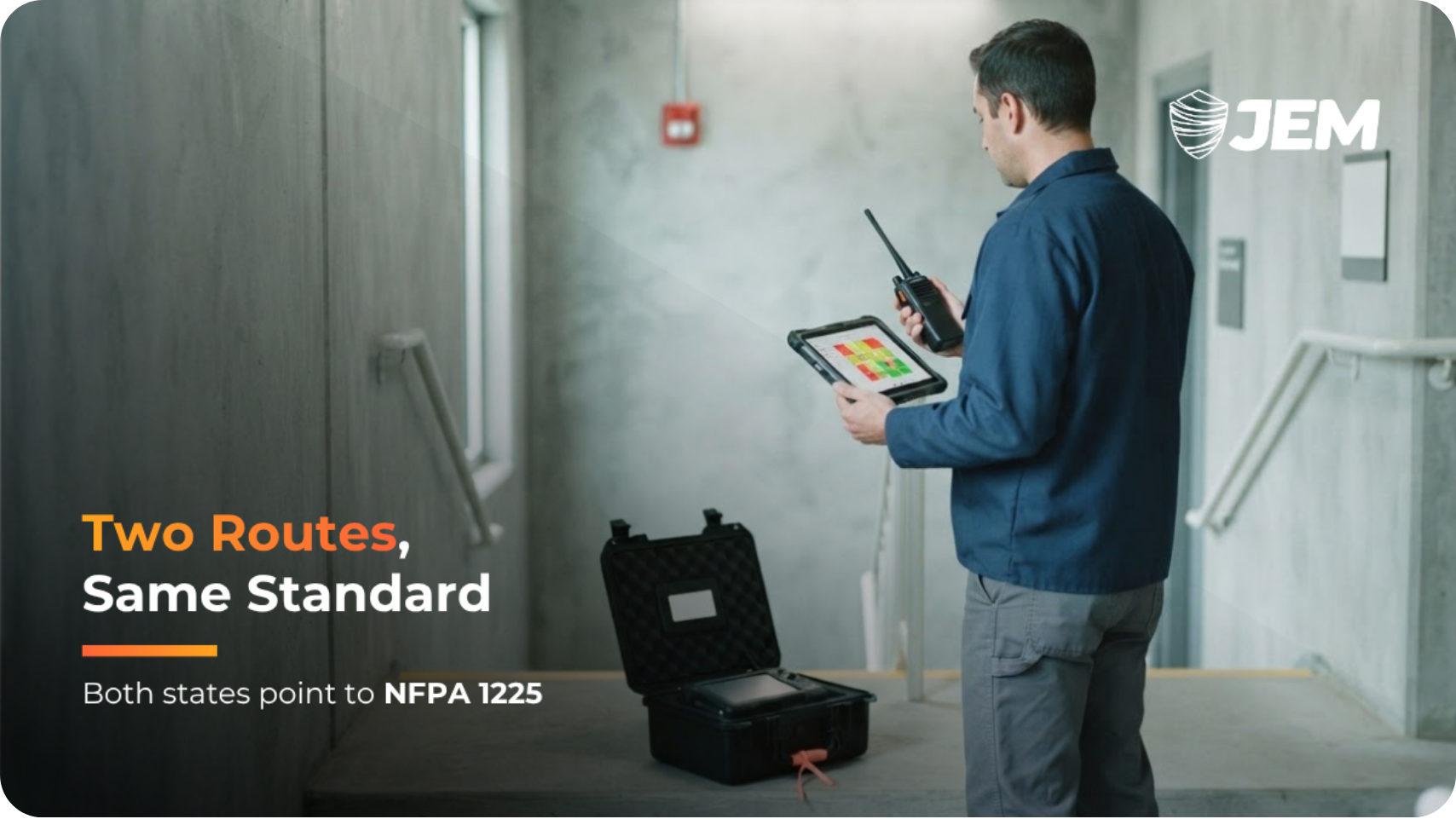
ERCES codes decide whether emergency responders can talk by radio inside a building. In 2026, two big states reach the same standard by different routes. As of November 2026, California’s 2025 fire code designs these systems to NFPA 1225, while Georgia’s state rule adopts Chapter 18 of the 2022 edition of NFPA 1225. In both states, the local authority having jurisdiction (AHJ) sets the details that shape your design. Below is what each state adopted, so you know what to confirm before you draw.
Key takeaways
- California: the 2025 California Fire Code took effect on January 1, 2026. Its Section 510 points ERCES design to NFPA 1225 and sets coverage at 95% of all areas and 99% of critical areas.
- Georgia: the state rule replaces IFC Section 510 and sends ERCES to Chapter 18 of NFPA 1225 (2022 edition), with the same 95–99% coverage range.
- Local control: in both states, the AHJ sets signal levels, critical areas and test methods.
- Fire alarm link: ERCES trouble signals usually report to the fire alarm system, so radio and fire alarm teams should plan together.
What is an ERCES?
An emergency responder communication enhancement system (ERCES) keeps public safety radios working inside a building. That matters because walls and floors can block the signal. For example, many systems pair a bi-directional amplifier (BDA) with a distributed antenna system (DAS) that carries the signal through the building. That is why the industry often calls the whole category BDA/DAS/ERCES.
Most ERCES codes rest on two documents: Section 510 of the International Fire Code (IFC) and NFPA 1225, whose Chapter 18 covers in-building ERCES. However, each state adopts them on its own schedule, and many states amend them.
California: ERCES codes in the 2025 Fire Code
The 2025 California Fire Code (Title 24, Part 9) took effect statewide on January 1, 2026. It is based on the 2024 IFC with state amendments, according to a City of Berkeley staff report.
Section 510 holds the state’s ERCES codes. It requires an approved ERCES in all new buildings. Still, there are exceptions. For example, one-story buildings of 12,000 square feet or less with no below-ground areas are exempt. The fire code official can also decide that a system is not needed at all.
Coverage and design
Under Section 510.4.1, a building passes when the signal meets the code in 95% of all areas and 99% of critical areas on each floor. The fire code official designates the critical areas. In addition, downlink and uplink must each reach a delivered audio quality (DAQ) of at least 3.0.
The design must follow Section 510 and NFPA 1225. Also, the equipment must be listed to UL 2524. Local guidance, such as the Burbank Fire Department’s ERRCS regulation, names the 2022 edition of NFPA 1225 as the referenced standard. Meanwhile, the fire code official keeps a technical document. It lists the frequencies, radio sites and maximum delay your design must meet.
Testing, people and the fire alarm link
For acceptance, the tester splits each floor into a grid of 20 roughly equal areas. Then, if more than one area fails, the test fails. In some cases, though, a 40-area retest is allowed. Section 510.5.3 also sets minimum qualifications for the designer and lead installation personnel. They need an FCC general radio operator license. In addition, they need in-building system training or a manufacturer certificate, unless the official accepts other proof of skill.
Next, Section 510.4.2.5 requires a listed fire alarm control unit to monitor the ERCES. Where approved, an audible signal at a constantly attended location can do the job instead. Separately, NFPA 72 (2025 edition) became the fire alarm code in California in the same cycle, according to the California Automatic Fire Alarm Association. In practice, that monitoring point is where the radio scope and the fire alarm scope meet.
Even so, local ERCES codes still matter. San Francisco, for instance, enforces its own 2025 fire code. It also requires an ERCES certification for vendors and contractors that design, install, test or maintain these systems in the city, according to the San Francisco Fire Department.
Georgia: ERCES codes in the state fire rules
Georgia builds its ERCES codes into the Rules and Regulations of the Safety Fire Commissioner, Chapter 120-3-3. As published by the Georgia Secretary of State (as of November 2026), Rule 120-3-3-.04 adopts the 2024 IFC with Georgia changes. It also replaces Section 510 in full, instead of amending it.
The Georgia version of Section 510 is short. First, the local fire chief or fire code official sets the minimum radio signal strength in new and existing buildings. Second, every ERCES must meet the design, installation, testing, inspection and maintenance rules in Chapter 18 of NFPA 1225, as the state adopted it.
What Georgia’s NFPA 1225 adoption says
Georgia’s adoption of the 2022 edition makes Chapters 1 through 3 and Chapter 18 the standard for in-building ERCES. It also states that the AHJ named by the local governing authority enforces the standard.
In addition, Georgia rewrote the list of critical areas. These areas need 99% floor area coverage:
- Fire command centers and fire pump rooms
- Exit stairs and exit passageways
- Elevators and elevator lobbies
- Standpipe cabinets and sprinkler sectional valve locations
- Other areas the AHJ deems critical
General building areas follow NFPA 1225 at 95%. So Georgia lands on the same 95–99% range as California.
One caution: the state’s rule filing does not show the date this NFPA 1225 adoption took effect. Meanwhile, the Georgia Office of Insurance and Safety Fire Commissioner says its updated Chapter 120-3-3 rules were implemented by May 27, 2025. So, if a schedule depends on the exact date, confirm it with that office or with your AHJ.
California vs. Georgia at a glance
| Item | California | Georgia |
|---|---|---|
| Code path | 2025 CFC Section 510, based on the 2024 IFC | Rule 120-3-3-.04 replaces IFC Section 510 |
| ERCES standard | NFPA 1225 | NFPA 1225 (2022), Chapters 1–3 and 18 |
| Coverage | 95% of all areas, 99% of critical areas | 95% of general areas, 99% of critical areas |
| Who sets local criteria | Fire code official | Local fire chief or fire code official |
| Fire alarm link | Monitored by a listed fire alarm control unit | Supervisory signals to the fire alarm system |
Three ERCES codes questions for your AHJ
Even where ERCES codes match on paper, the AHJ controls the inputs. So, settle these three questions before the first drawing.
- Which edition and which local amendments apply? Adoption dates differ, and cities such as San Francisco add their own rules. The wrong document means rework.
- What coverage, signal levels and critical areas apply? Ask for the AHJ’s technical criteria document. Both CFC Section 510.4.2.2 and NFPA 1225 call for one. It should list frequencies, radio sites and delay limits.
- How will acceptance testing work? Ask about the grid method, who witnesses the test and who signs it. NFPA 1225 requires a test signed by a person the AHJ approves, at acceptance and every 12 months.
Get the answers in writing. After all, a phone call now avoids rework after the equipment is specified.
Build the submittal package early
Under NFPA 1225, the AHJ and the frequency license holder must both approve the design. Then the license holder must give written authorization before the system goes live. As a result, a complete package cuts the back and forth.
The NFPA 1225 annex lists what a design submittal should include, as appropriate. For example, highlights include:
- Signal source measurements and building floor plans
- Donor link budgets and antenna isolation calculations
- Backup power calculations and the monitoring design, including fire alarm interfaces
- Predictive coverage maps and test grids on floor plans
- Designer qualifications and equipment cut sheets
If your team needs support here, JEM provides BDA design along with a complete submittal package ready for AHJ approval, and helps teams obtain manufacturer certifications.
What this means for contractors
ERCES codes now look alike on paper in California and Georgia. Even so, the details still sit with the local AHJ. In practice, a few habits pay off on every job:
- Start with the AHJ, not the catalog. Confirm the edition, amendments and technical criteria before you select a BDA.
- Map critical areas early. Stairs, elevator lobbies and fire command centers drive the 99% target within the 95–99% range.
- Coordinate with the fire alarm team, because ERCES trouble signals usually report to the fire alarm system.
- Check people, not only parts. California sets designer and lead installation qualifications, and some cities add their own certifications.
- Plan for testing twice. Acceptance is only the first test, since NFPA 1225 also calls for annual testing.
For surveys and commissioning, JEM’s PCTEL testing offers RF testing and expert analysis for public safety networks and commercial buildings.
Frequently asked questions
What does ERCES stand for?
Emergency responder communication enhancement system. It keeps public safety radios working inside buildings.
Does every new building in California need an ERCES?
Section 510 requires one in new buildings. However, it lists exceptions, and the fire code official can decide a system is not needed. Confirm with your AHJ.
Who enforces ERCES requirements in Georgia?
The local AHJ. Under Georgia’s ERCES codes, the AHJ designated by the local governing authority enforces NFPA 1225.
What does a BDA do?
A bi-directional amplifier boosts public safety radio signals in both directions. Downlink runs from the base station to the portable radio. Uplink runs the other way.
Finally, are you planning a BDA/DAS/ERCES project? Request a BDA price from the JEM team.
This article is general information and does not replace the requirements of your jurisdiction. Confirm the applicable codes with your AHJ.
Read next: Mastering Complex Infrastructure: The Power of BIM in Modern Fire & Life Safety
Sources
- 2025 California Fire Code, Section 510 (reading copy), GoCodebook, accessed Nov. 6, 2026. Official editions: California Building Standards Commission
- 2025 California Fire Code adoption, City of Berkeley (Nov. 10, 2025)
- ERRCS regulation, Burbank Fire Department (Sept. 1, 2025)
- NFPA 72-2025 in California, California Automatic Fire Alarm Association
- ERCES Certification (2025), San Francisco Fire Department
- Rule 120-3-3, Georgia Secretary of State, accessed Nov. 6, 2026
- Adoption of NFPA 1225 (2022), Georgia Insurance and Safety Fire Commissioner
- NFPA 1225 (2022), Chapter 18 extract, Georgia Insurance and Safety Fire Commissioner
- Inspections, Permits & Plans, Georgia Insurance and Safety Fire Commissioner
Leave a Reply