
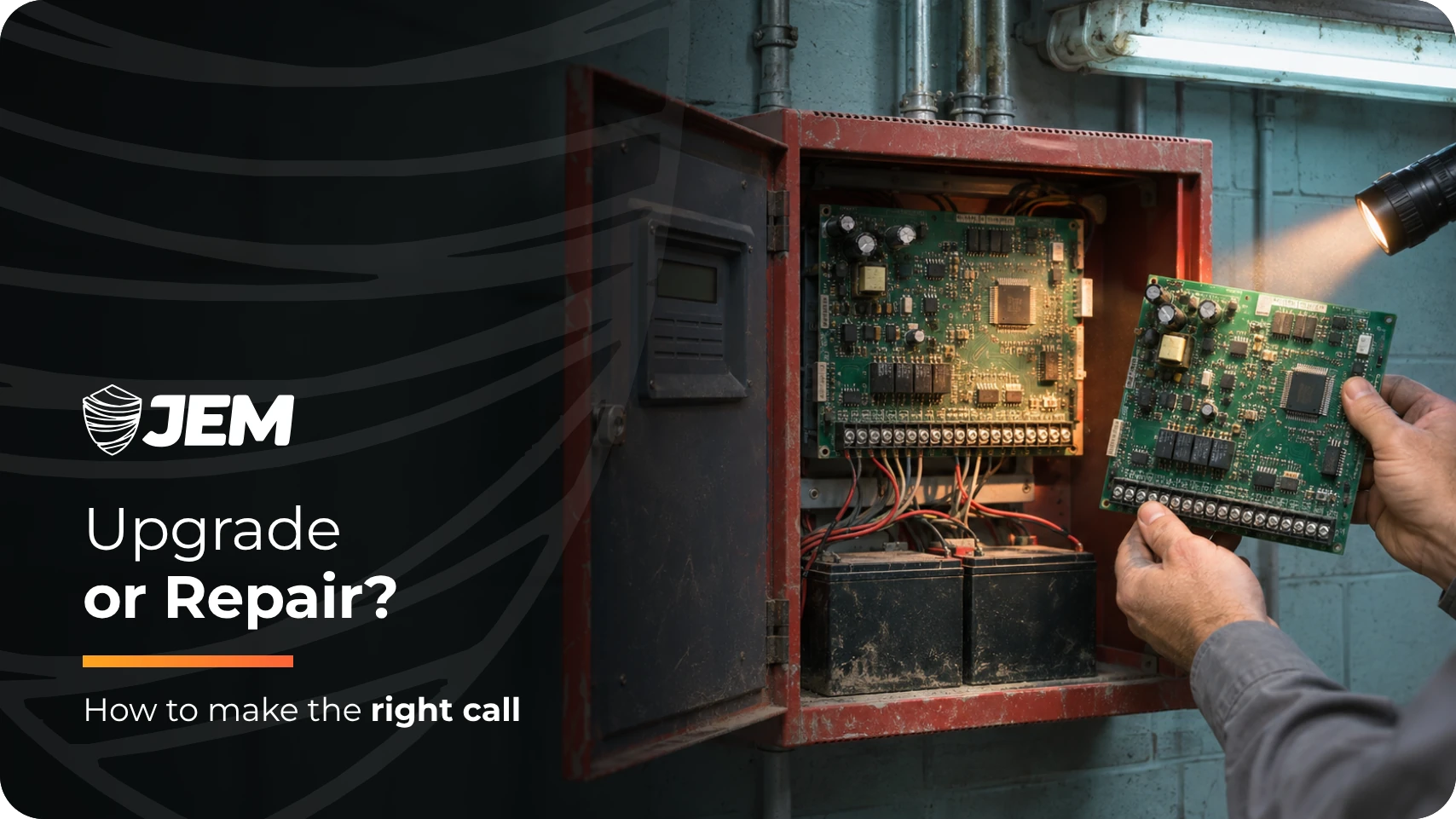
Every aging fire alarm system reaches the same fork in the road: fix it again, or replace it. The wrong call can cost an owner twice, first for repairs that do not last and then for the new system anyway. So, this guide walks through what the codes say, what a discontinued panel really means and how to compare a repair with a fire alarm upgrade, as of November 2026.
Key takeaways
- Age alone is not the trigger: if a system works and you can maintain it, the codes may not require a fire alarm upgrade.
- Serviceability is: NFPA 1, as quoted by a code expert, requires owners to replace required systems that cannot be serviced or repaired.
- Discontinued does not mean dead, but parts and support get harder over time.
- Any change has a cost: repairs and upgrades both trigger reacceptance testing under NFPA 72.
When the codes require a fire alarm upgrade
First of all, many owners think the law forces them to replace an old system. However, that is often not the case. As Wayne D. Moore wrote in Electrical Contractor in 2019, neither NFPA 72 nor the building codes require changes or upgrades if a system is working properly and can be maintained.
On the other hand, the picture changes when no one can keep a system running. In a 2024 Electrical Contractor column, Moore quoted NFPA 1, Section 13.7.1.5.7: the system owner shall replace required fire alarm systems that cannot be serviced or repaired. In other words, the question is not “how old is it?” but “can we still fix it?”
Section numbers can shift between editions, so confirm the edition your AHJ enforces.
What a discontinued panel means
Meanwhile, manufacturers retire panel families from time to time. For example, Silent Knight’s retirement notice of April 2018 said it would stop offering the 5700, 5808, 5820XL and 5820XL-EVS panels after June 30, 2018. In turn, it named the 6700, 6808, 6820 and 6820EVS as replacements.
More recently, Tech Electronics reported in August 2026 that Honeywell announced a phaseout of the Notifier NFS-320 platform, with the Inspire Series as the path forward. Notably, the same article said the phaseout does not mean existing NFS-320 systems need to be replaced right away.
So, a discontinued panel is a warning, not a deadline. Still, over time, spare boards, software and trained techs can become harder to find. That is when a repair job starts to turn into a fire alarm upgrade.
Repair or fire alarm upgrade: a decision checklist
Before you recommend either path, ask a few plain questions:
- Can you still get parts? Check the maker’s support status and stock for boards and devices.
- Is the software supported? Make sure you can still program the panel with current tools.
- How often does it fail? Chronic troubles and nuisance alarms are a red flag.
- What does the building need next? A new tenant, a change of use or voice evacuation may change the scope.
- What will testing cost after the work?
Then, put both options side by side over several years, not just this quarter.
Repairs have hidden costs too
Of course, a repair looks cheaper on day one. However, every change to the system brings testing. According to a Minnesota Department of Health testing guide (June 2024), NFPA 72 calls for reacceptance testing after changes such as adding or deleting components, or any repair or adjustment to hardware or wiring.
For a software change, the same guide says to test 100% of the affected functions, plus 10% of the unaffected initiating devices, up to 50 devices. As a result, even a “small” fix can mean a real test day.
Planning a fire alarm upgrade the smart way
So, if the answer is to upgrade, plan it in phases where you can. For example, the Kidde Commercial Evolve series is designed to replace legacy panels without changing existing wiring or conduit, as our Kidde article explains. That can cut tear-out and downtime. Still, always check device compatibility with the maker’s documents first.
Also, keep the paperwork clean. NFPA 72 requires a record of all inspections, testing and maintenance, as the Minnesota guide notes. In addition, Moore explained in 2021 that NFPA 72 (2019) calls for documenting the compatible software or firmware versions at the initial acceptance test and at any reacceptance tests.
What this means for contractors
Overall, the best advice is honest advice. In practice:
- Start with serviceability, not age.
- Show the owner both paths with a multi-year cost view.
- Price the testing into every repair and upgrade.
- Document software versions and keep records ready for the AHJ.
For new or replacement system design, JEM’s Fire Alarm Design team prepares device layouts, riser diagrams, battery calculations and submittals. Also, to compare panel families and parts, browse JEM’s product lines by brand.
Frequently asked questions
Does an old fire alarm system need replacing?
Not by age alone. If it works and you can maintain it, the codes may not require a fire alarm upgrade. Still, check with your AHJ.
What if parts are no longer available?
NFPA 1, as quoted in Electrical Contractor, requires owners to replace required systems that cannot be serviced or repaired.
Do repairs require retesting?
Yes. NFPA 72 calls for reacceptance testing after repairs and other changes to the system.
This article is general information and does not replace the requirements of your jurisdiction. Confirm the applicable codes with your AHJ.
Read next: Kidde Fire Safety for Contractors: Evolve, Legacy Panels and Training
Sources
- Upgrade or replace? Assisting customers with their fire alarm system decisions, Wayne D. Moore, Electrical Contractor (May 15, 2019)
- Visible notification appliances and FACU replacements, Wayne D. Moore, Electrical Contractor (October 15, 2024)
- What repairs made to a fire alarm system trigger a complete system replacement?, Electrical Contractor (November 15, 2021)
- Silent Knight 5000 series product retirement notice (April 18, 2018)
- Honeywell announces phaseout of NFS-320 fire alarm control panels, Tech Electronics (August 17, 2026)
- Inspection and Testing of Fire Alarm Systems, Minnesota Department of Health (June 2024)
Leave a Reply