
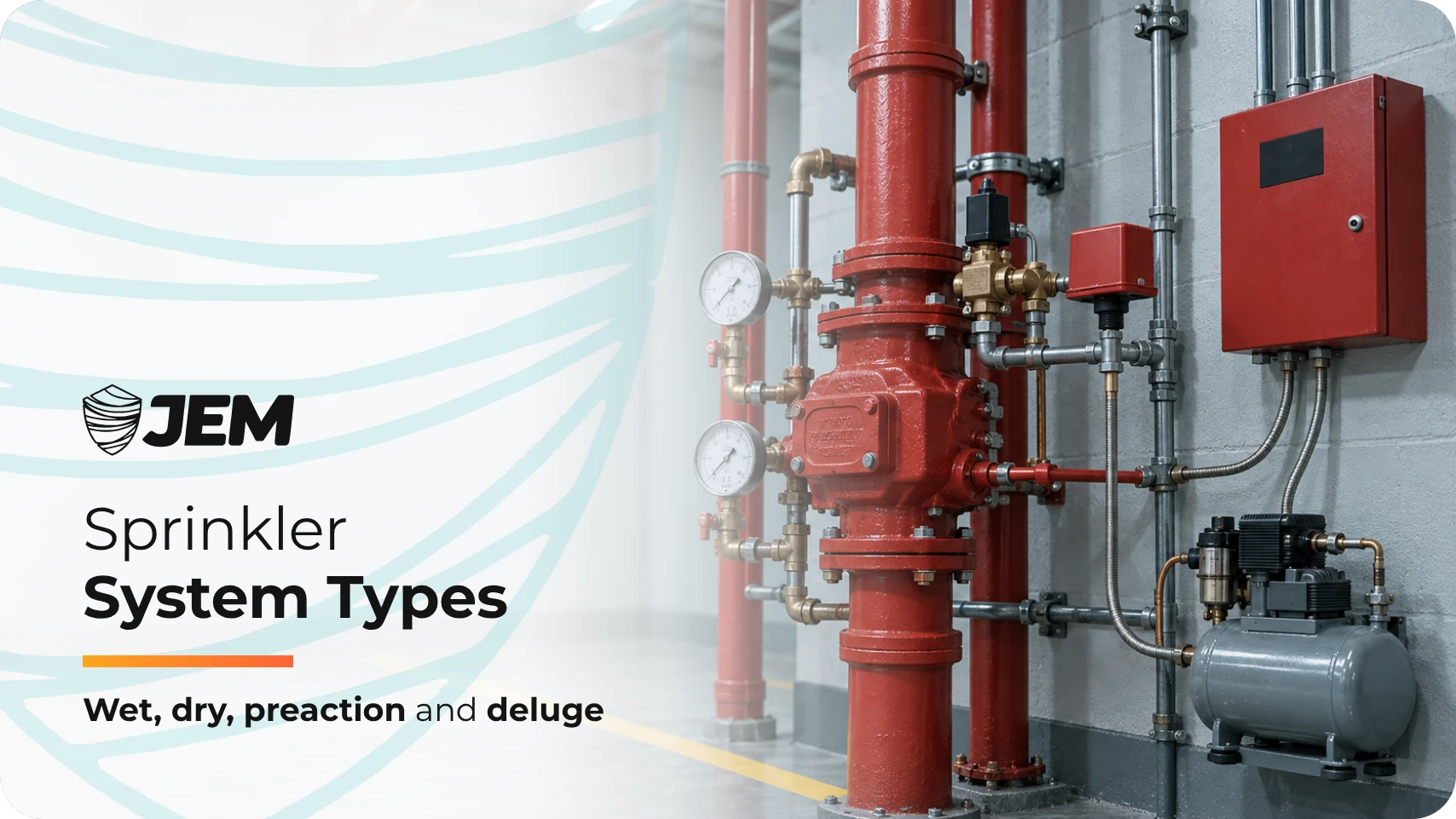
Not every building can use the same sprinkler system. A heated office, a freezing parking deck, a museum archive and an aircraft hangar each face different risks. So, NFPA 13 recognizes several sprinkler system types, each built for a different job. This guide explains the four main types, where each one fits and how they connect to the fire alarm system, as of November 2026.
Key takeaways
- Wet pipe is the most common type, but it needs above-freezing temperatures.
- Dry pipe holds pressurized air or nitrogen, so it works where pipes could freeze.
- Preaction aims to prevent accidental discharge, which suits data centers, libraries and museums.
- Deluge uses open sprinklers for high-hazard areas.
Why sprinkler system types matter
Above all, the right system depends on the space. For example, temperature, the value of the contents and the hazard level all shape the choice. In turn, that choice affects cost, maintenance and how the system ties into the fire alarm.
In the U.S., NFPA 13, the Standard for the Installation of Sprinkler Systems, sets the rules. According to QRFS, the 2025 edition is the newest one. Among other changes, it reorganized the dry system section and added vacuum dry and vacuum preaction systems.
The four main sprinkler system types
To start, the National Fire Sprinkler Association describes four main types. Here is how each one works, and where it fits best.
Wet pipe: water always in the pipes
First, wet pipe systems keep water in the pipes at all times. When a sprinkler opens, water flows right away. According to NFSA, wet pipe is the most common type. However, it only works in buildings that stay above freezing.
Dry pipe: built for cold spaces
Dry pipe systems use pressurized air or nitrogen in the pipes, as NFSA notes. When a sprinkler opens, the air escapes and water then flows into the pipes. For that reason, NFSA calls dry pipe ideal for areas where the temperature can fall below freezing, such as unheated spaces.
Preaction: for water-sensitive spaces
By contrast, preaction systems aim to prevent accidental discharge of water. As a result, NFSA lists uses such as data centers, libraries and museums. Also, they come in three forms, as defined in NFPA 13 (2019) and quoted by PHCP Pros:
- Single interlock: admits water to the piping when detection devices operate.
- Double interlock: admits water only when both detection devices and automatic sprinklers operate.
- Non-interlock: admits water when either detection devices or automatic sprinklers operate.
Deluge: for high-hazard areas
Deluge systems keep the pipes dry and use open sprinkler heads, according to NFSA. So, when the system activates, water flows from every head at once. Therefore, NFSA lists high-hazard uses such as aircraft hangars and chemical storage.
How sprinkler system types tie into the fire alarm
Clearly, the fire alarm contractor has a role here. Typically, waterflow and supervisory switches on the sprinkler side can report to the fire alarm panel. Meanwhile, preaction and deluge systems depend on detection devices to admit water, as the NFPA 13 definitions above show. In other words, design and test the detection and release side together with the sprinkler side, not after it.
How well do sprinklers perform?
Overall, NFPA data supports sprinklers in general. In a 2022 NFPA Journal article, Marty Ahrens reported that sprinklers operated in 92% of the fires studied (2015 to 2019 data). Also, they were effective in 96% of the fires where they operated.
An older NFPA report also compared types. Based on 2005 to 2009 data, wet pipe sprinklers operated in 92% of the fires studied versus 80% for dry pipe, according to John R. Hall Jr.’s 2011 report. So, dry systems need careful design and maintenance to perform well.
What this means for contractors
Overall, choosing among sprinkler system types is a design decision with long-term effects. In practice:
- Match the type to the space, not to habit.
- Plan freeze protection early in unheated areas.
- Coordinate detection and release on preaction and deluge jobs.
- Use the current NFPA 13 edition your AHJ enforces.
For more on the design side, read our article on sprinkler design. For stamped designs, JEM’s Sprinkler Design team works with PE engineers who bring over 25 years of experience.
Frequently asked questions
What is the most common sprinkler system type?
Wet pipe, according to NFSA. Still, it needs above-freezing temperatures.
When should I use a dry pipe system?
Use it where pipes could freeze, such as in unheated spaces. In that case, air or nitrogen fills the pipes instead of water.
What is the difference between single and double interlock preaction?
Single interlock admits water when detection operates. Double interlock needs both detection and a sprinkler to operate.
This article is general information and does not replace the requirements of your jurisdiction. Confirm the applicable codes with your AHJ.
Read next: The Critical Role of Smoke Detection in Data Centers
Sources
- Types of fire sprinkler systems, National Fire Sprinkler Association (June 25, 2024)
- Specifying preaction systems, PHCP Pros (January 6, 2020)
- NFPA 13 2025 edition: reviewing major changes, part 1, QRFS (May 12, 2026)
- U.S. Experience with Sprinklers, Marty Ahrens, NFPA Journal (Spring 2022)
- U.S. Experience with Sprinklers, John R. Hall Jr., NFPA (May 2011)


Leave a Reply