
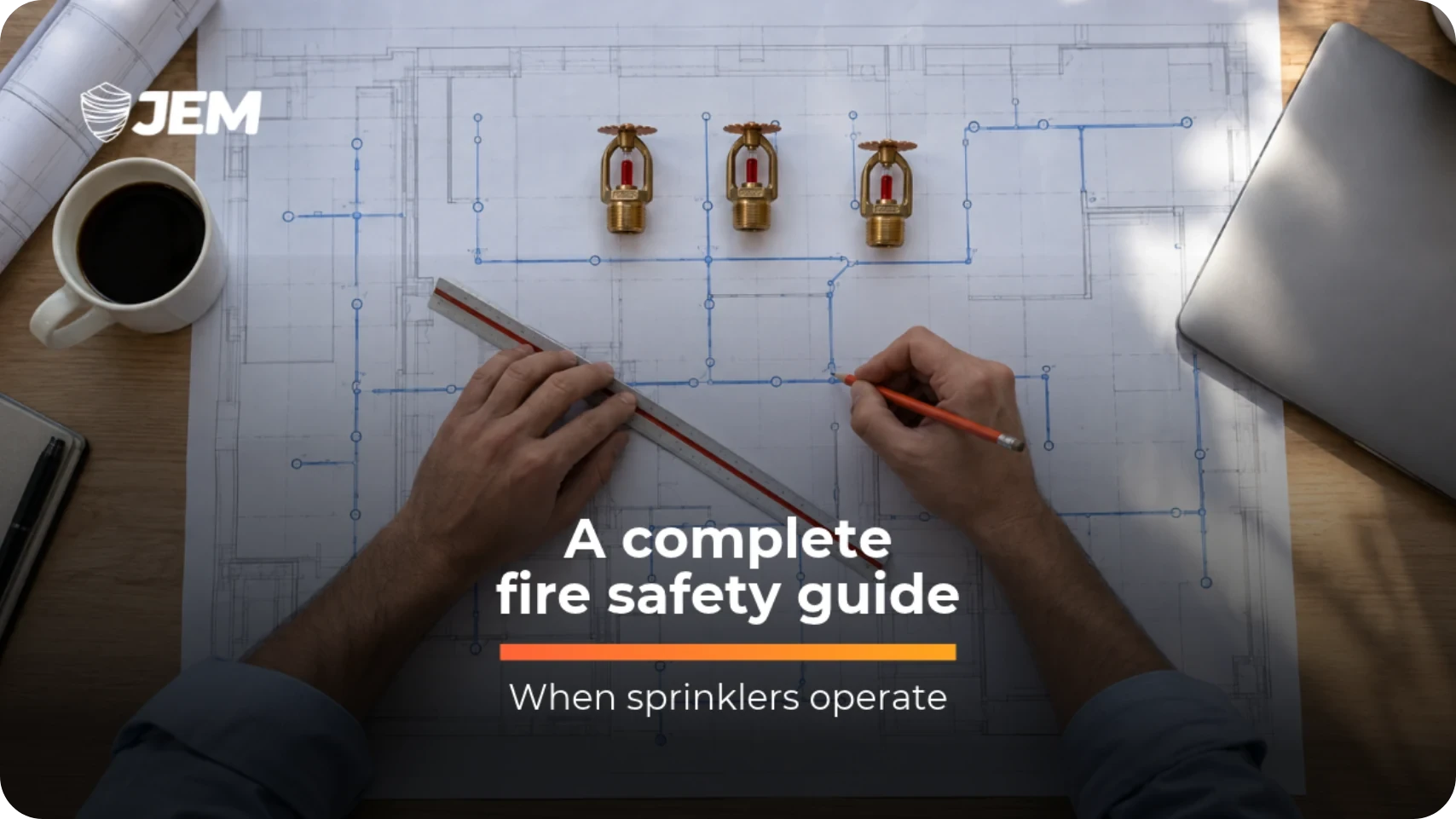
Sprinkler design is the engineering work that decides where every sprinkler goes, how much water each one needs, and whether the water supply can deliver it. Done well, it turns a code requirement into a system that controls a fire with very few heads. In the U.S., most of that work follows NFPA 13, now in its 2025 edition. Below is what a sprinkler design covers, which standard applies, and what the latest data says about performance, as of November 2026.
Key takeaways
- Sprinklers work: from 2020 to 2024, sprinklers operated in 90% of fires large enough to trigger them and controlled the fire in 97% of those cases, per NFPA.
- Pick the right standard: NFPA 13 covers most buildings, while NFPA 13R and 13D cover certain residential occupancies.
- Hazard drives design: the occupancy hazard class sets the water density and the design area.
- The 2025 edition changed details that affect storage, light hazard systems and the water supply analysis.
What is sprinkler design?
A sprinkler design starts with the building and its contents. Then, it moves to the water. Next, the designer classifies each space, sets the design criteria, lays out the pipe and heads, and checks that the water supply can meet the demand.
NFPA 13, the Standard for the Installation of Sprinkler Systems, is the main U.S. reference. In fact, NFPA describes it as the industry benchmark for the design and installation of automatic sprinkler systems. As of November 2026, its current edition is 2025.
Which sprinkler design standard applies?
Three NFPA standards cover most projects:
- NFPA 13 is the main standard for most commercial and industrial buildings.
- For low-rise residential occupancies, NFPA 13R applies.
- One- and two-family dwellings and manufactured homes fall under NFPA 13D.
Also, all three are in their 2025 editions. Still, the edition your project follows depends on what your state and your AHJ have adopted. So, confirm it before design starts.
How hazard classification shapes sprinkler design
Under NFPA 13, each space gets an occupancy hazard class. Specifically, the classes are light hazard, ordinary hazard (Groups 1 and 2) and extra hazard (Groups 1 and 2). In an NFPA blog post republished by PHCP Pros, NFPA engineer Robin Zevotek explains how they differ:
- Light hazard covers spaces with a low amount of low-combustibility contents.
- Ordinary hazard Group 1 limits stockpiles to 8 feet. Group 2, however, allows taller piles, depending on how fast the contents burn.
- Extra hazard Group 1 covers spaces where dust and lint are present. Similarly, Group 2 covers spaces with moderate to large amounts of flammable or combustible liquids.
As a result, the class sets the design criteria, often as a density of water applied over a set area. Zevotek also notes that these classes are not the same as the occupancy types in building or fire codes. In other words, a school can hold light, ordinary and extra hazard spaces under one roof.
What a sprinkler design project includes
For that reason, a complete design usually covers these steps:
- Review the building: use, construction, ceilings and storage.
- Classify each space under NFPA 13.
- Set the design criteria for each area.
- Lay out pipe and sprinklers around beams, ducts and other obstructions.
- Run the hydraulic calculations and compare them with the water supply.
- Prepare the submittal for the AHJ.
Water supply also needs care. In its preview of the 2025 edition, the National Fire Sprinkler Association (NFSA) points to a change in the owner’s certificate. As a result, the water supply study is now the job of the owner or the owner’s agent.
What changed in the 2025 edition of NFPA 13
NFSA’s preview lists several changes. However, a few stand out for designers:
- Sloped ceilings in storage: for the first time, sloped ceilings are allowed for storage occupancies, with set protection options.
- Light hazard wet systems: the area limit for electrically supervised systems rises from 52,000 to 78,000 square feet.
- New system options: vapor corrosion inhibitor and vacuum systems are added to the standard.
NFSA wrote its preview before publication and warned that section numbers could shift. In addition, NFPA has issued tentative interim amendments to the 2025 edition since then. Therefore, check the final text and any amendments before you rely on a section number.
Why good sprinkler design matters
Why does it matter so much? The data makes the case. NFPA’s U.S. Experience with Sprinklers report (October 1, 2026) covers fires from 2020 to 2024:
- Compared with properties with no automatic extinguishing system, the civilian fire death rate was 90% lower where sprinklers were present.
- Also, fire spread stayed in the object or room of origin in 93% of fires with sprinklers, versus 68% with no system.
- Finally, in 76% of fires where sprinklers operated, only one sprinkler operated.
Even so, design is only part of reliability. According to the same report, the most common reason sprinklers failed to operate was that the system had been shut off before the fire.
What this means for contractors
Overall, sprinkler design sets the cost, the schedule and the inspection result of the job. So, in practice:
- Confirm the standard and edition with the AHJ before you price.
- Get the hazard class right, since it drives pipe size and water demand.
- Ask for the water supply data early, because the owner now carries that analysis.
- Coordinate with other trades, since ducts and beams change the layout.
JEM’s Sprinkler Design service is built around competitive pricing, fast turnaround and expert support. In addition, the page offers sample designs to download. Have a project? Submit it to the JEM team.
Frequently asked questions
What is the difference between NFPA 13, 13R and 13D?
In short, NFPA 13 is the general standard. NFPA 13R covers low-rise residential occupancies, and NFPA 13D covers one- and two-family dwellings and manufactured homes.
Who is responsible for the water supply analysis?
Under the 2025 edition, it falls to the owner or the owner’s agent, as NFSA notes.
How many sprinklers usually operate in a fire?
Usually just one. For example, NFPA found that only one sprinkler operated in 76% of fires where sprinklers operated, from 2020 to 2024.
This article is general information and does not replace the requirements of your jurisdiction. Confirm the applicable codes with your AHJ.
Read next: Grow Your Fire & Life Safety Career with NICET Training
Sources
- NFPA 13, Standard for the Installation of Sprinkler Systems, NFPA (current edition: 2025)
- NFPA 13R, Standard for the Installation of Sprinkler Systems in Low-Rise Residential Occupancies, NFPA (current edition: 2025)
- Changes in the 2025 Edition of NFPA 13, TechNotes, National Fire Sprinkler Association (July 23, 2024)
- NFPA 13D, Standard for the Installation of Sprinkler Systems in One- and Two-Family Dwellings and Manufactured Homes, NFPA (current edition: 2025)
- U.S. Experience with Sprinklers, NFPA Research, Tucker McGree (October 1, 2026)
- NFPA 13 Occupancy Classifications for Fire Sprinkler Systems, Robin Zevotek, PHCP Pros (March 3, 2025)

Leave a Reply