
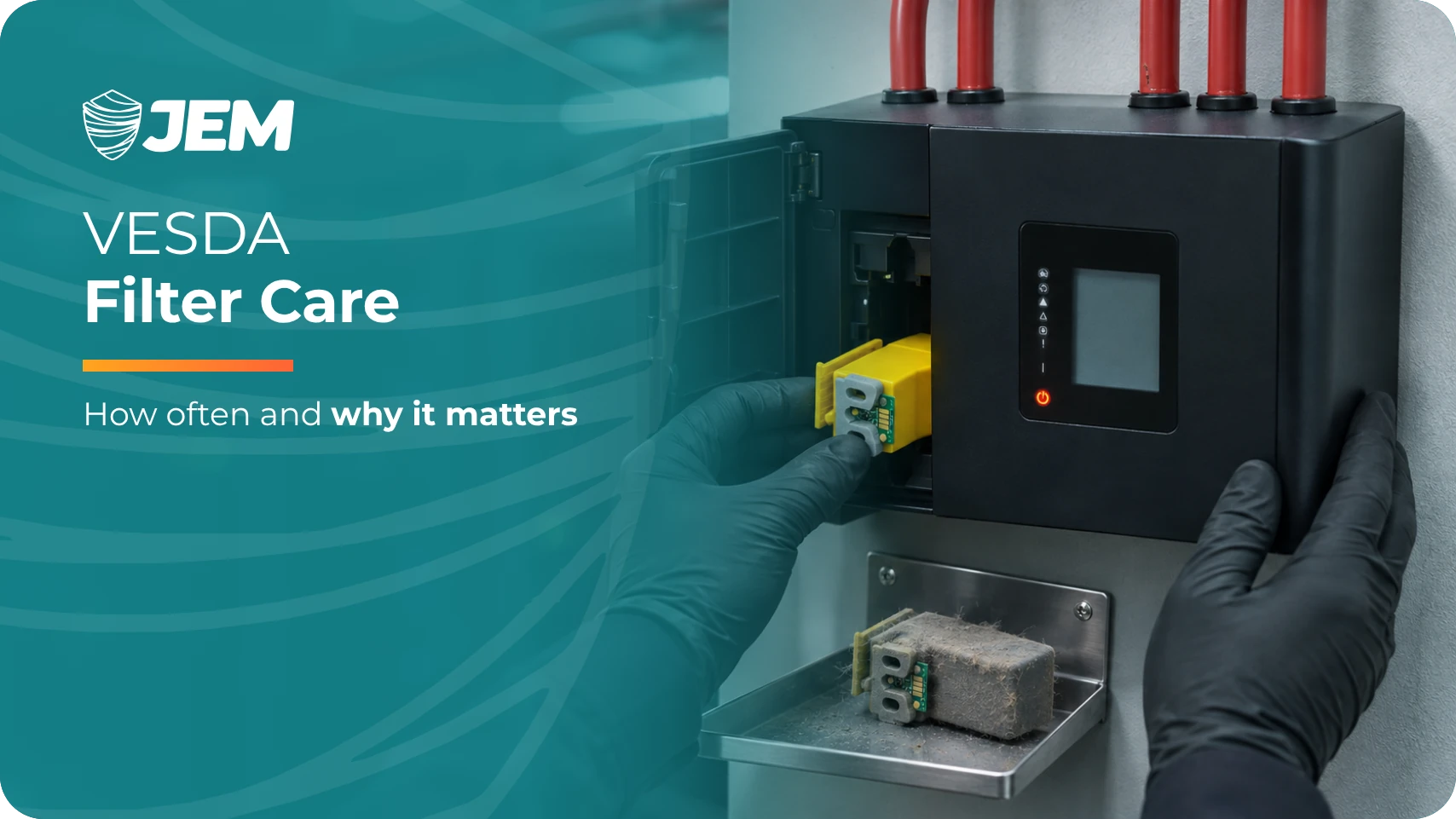
An aspirating smoke detector is only as good as the air it samples. Dust that reaches the detection chamber can affect how well the detector works. That is the job of the VESDA filter: it keeps dust out of the chamber so the detector can do its work. Below is what the filter does, how often Xtralis says to replace it and how to build replacement into your service plan, as of November 2026.
Key takeaways
- The filter protects the detector: it removes dust from sampled air and helps keep the chamber optics clean.
- No single interval: Xtralis ties replacement to the environment, from 12 months in harsh spaces up to 60 months in clean rooms.
- It is single use: the filter cannot be cleaned and reused.
- Testing follows the maker: NFPA 72 points to the manufacturer’s methods for aspirating detectors.
What the VESDA filter does
First, VESDA detectors pull air through a pipe network and into a detection chamber. According to the Xtralis VESDA Filter Replacement document (August 2021), the filter removes dust contamination from the sampled air. It also supplies clean air that helps protect the chamber optics.
In other words, the filter guards the part of the detector that sees smoke. As a result, a clogged or old filter can affect how well the system performs over time.
On VESDA-E models, the VESDA-E FAQ (January 2026) says each detector has one field replaceable filter. Specifically, it lists part number VSP-962 for VEU, VEP and VES detectors, and VSP-972 for the VEA.
How often to replace a VESDA filter
However, there is no one number for every site. Instead, Xtralis says to replace the filter in line with the environmental conditions of the protected area. Then, its document sets maximum intervals by class:
- Class 1 (clean room type): up to 60 months.
- Class 2: up to 36 months.
- For Class 3: up to 24 months.
- Class 4: up to 18 months.
- Class 5: up to 12 months.
For Class 6, which covers special cases, there is no fixed interval. Instead, Xtralis advises close monitoring for the first 3 to 6 months.
Also, some conditions call for more frequent changes. For example, Xtralis lists frequent access, building leakage, high humidity, cooking or production, and dusty ceiling voids. Meanwhile, a simpler Xtralis guidance page suggests replacing the filter every two years, and right away if its label matches the warning colors on the label chart.
A VESDA filter is single use
Above all, do not try to clean a filter. Xtralis states that the filter is for single use only and cannot be cleaned and reused. Likewise, the VESDA-E FAQ says the same about the cartridge.
Smart filters and fault signals
Fortunately, newer detectors help you plan. The VESDA-E VEP datasheet (July 2025) says its smart on-board filter retains the dust count and the remaining filter life. In turn, that supports predictable maintenance. Similarly, the FAQ notes the same smart filter on VEU detectors.
The VEP datasheet also lists a “Filter Fault” indicator among its status icons. So, check the detector’s status and event log at every visit, not only at the annual test.
Testing aspirating systems under NFPA 72
Of course, filter changes sit inside a wider test program. According to a System Sensor applications guide, testing requirements come from NFPA 72 and the manufacturer’s recommendations. The guide also says the maximum transport time for a standard fire detection system, from the most remote hole to the detector, cannot exceed 120 seconds.
Similarly, ORR Protection noted in 2020 that the code says to follow the manufacturer’s methods for testing. Therefore, keep the maker’s test steps with your inspection forms.
Build VESDA filter replacement into service
Finally, a few habits make filter work routine:
- Classify each site with the Xtralis environment classes, and record the class.
- Set the interval from that class, then shorten it if conditions are harsh.
- Stock the right part, such as VSP-962 or VSP-972, before the visit.
- Log the date and the detector status after each change.
For the bigger picture on aspirating detection, read our article on early detection in data centers.
What this means for contractors
Overall, filter replacement is small work with a big effect on reliability. In practice:
- Follow the maker, not a rule of thumb.
- Match the interval to the environment.
- Use the status data that newer detectors provide.
- Document every change for the owner and the AHJ.
JEM lists VESDA detectors, filters and parts on its VESDA brand page. Also, for new systems, JEM’s Early Detection team provides pipe layouts, flow calculations and complete submittal packages.
Frequently asked questions
How often should I replace a VESDA filter?
It depends on the environment. In short, Xtralis sets maximum intervals from 12 to 60 months by class, with more frequent changes in harsh conditions.
Can I clean and reuse the filter?
No. Xtralis says the filter is single use and cannot be cleaned.
Which filter fits a VESDA-E detector?
The VESDA-E FAQ lists VSP-962 for VEU, VEP and VES, and VSP-972 for VEA.
This article is general information and does not replace the requirements of your jurisdiction. Confirm the applicable codes with your AHJ.
Read next: Fire Alarm Upgrade vs. Repair: How to Make the Right Call
Sources
- VESDA Filter Replacement, Xtralis (Doc 32694_04, August 2021)
- VESDA-E FAQ, Xtralis (Doc 26841_15, January 2026)
- The importance of filter replacement in VESDA detectors, Xtralis
- VESDA-E VEP datasheet, Xtralis (Doc 36106_07, July 2025)
- Aspirating Smoke Detection Applications Guide, System Sensor
- Air sampling smoke detection, ORR Protection (September 10, 2020)

Leave a Reply