
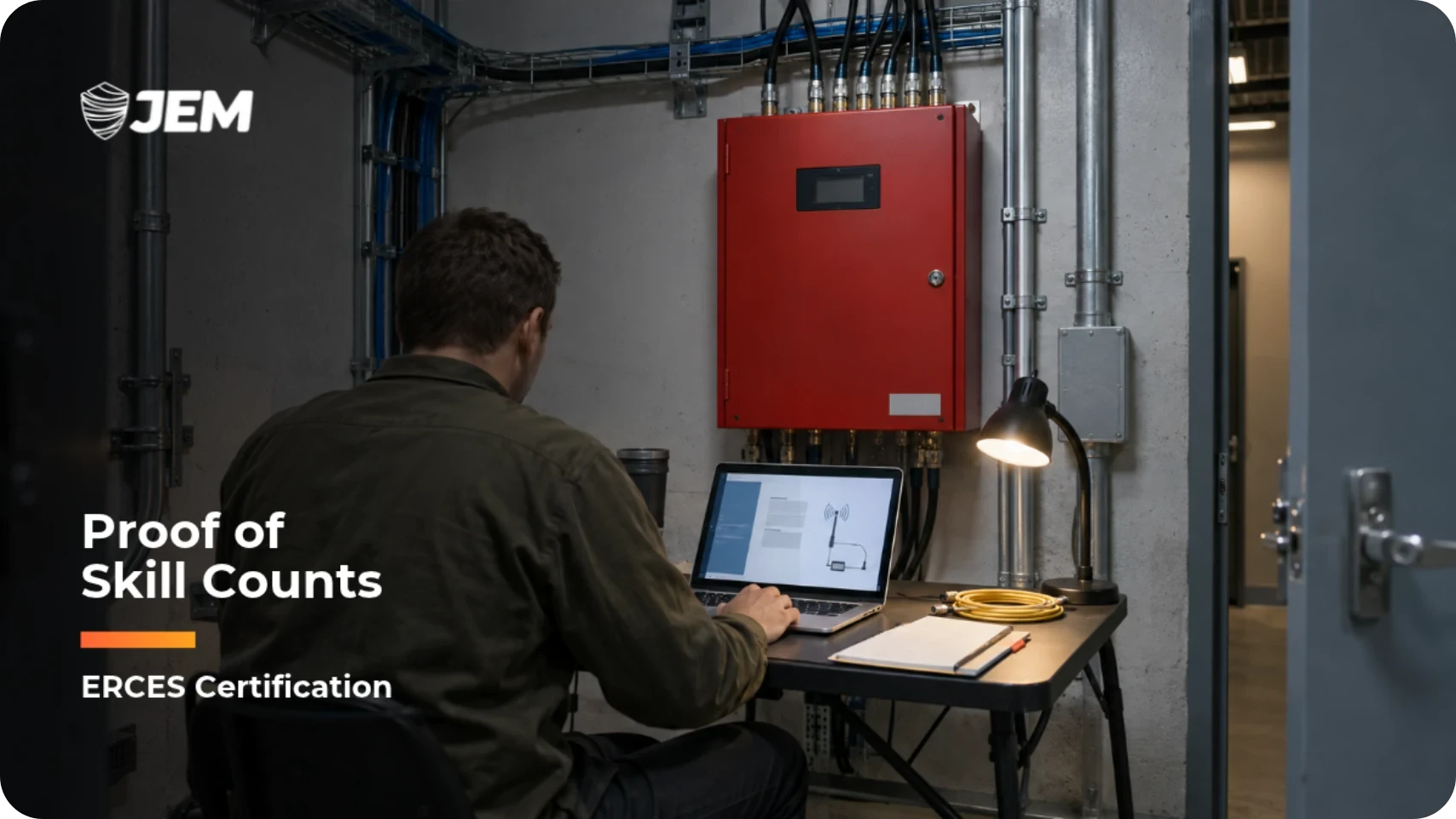
ERCES certification is moving from a nice extra to a line item in the submittal. Some codes and AHJs now ask who designed, installed and tested the in-building radio system, and what proof of skill that person holds. For fire alarm and low-voltage teams moving into public safety DAS, the question is where to start. Below are the main training paths, what a good course should cover, and what the codes say, as of November 2026.
Key takeaways
- The codes: ERCES rests on IFC Section 510 and NFPA 1225, with coverage set at 95–99% depending on the area.
- People matter: California’s 2025 Fire Code sets minimum skills for ERCES designers and lead installers.
- Several paths: NICET, brand training and online courses each fill a different need.
- Plan the mix: pair a known credential with brand training for the gear you use.
What ERCES certification covers
An ERCES (emergency responder communication enhancement system) keeps fire and police radios working inside a building. Walls and floors block radio signals, so the system boosts them. Many systems pair a bi-directional amplifier (BDA) with a distributed antenna system (DAS). That is why the industry calls the whole category BDA/DAS/ERCES.
Most ERCES rules rest on two documents: IFC Section 510 and NFPA 1225, whose Chapter 18 covers in-building systems. For example, California’s 2025 Fire Code, Section 510.4.1, requires coverage in 95% of all areas and 99% of critical areas, per the GoCodebook reading copy. Georgia’s adoption of the 2022 edition of NFPA 1225 lands on the same 95–99% range, according to the Georgia Insurance and Safety Fire Commissioner. Our ERCES codes article compares both states side by side.
Why ERCES certification matters to the AHJ
However, some codes now set rules for people, not just gear. California’s 2025 Fire Code, Section 510.5.3, sets minimum skills for the designer and the lead installer. Both need an FCC general radio operator license. They also need in-building system training or a manufacturer certificate, unless the fire code official accepts other proof.
Cities can also add their own rules. For example, the San Francisco Fire Department requires its own ERCES certification for this work in the city, from design to testing and upkeep. A listing body issues it. So, before you bid, ask what the local AHJ wants to see.
Path 1: NICET in-building public safety communications
NICET’s In-Building Public Safety Communications (IB-PSC) program is a national path. It is run by NICET, not by a maker. According to the NICET candidate handbook (August 2026), it has three technician levels and one design track:
- Level I: at least 6 months of in-building experience and the Level I exam.
- For Level II, at least 2 years and both the Level I and Level II exams.
- At Level III, at least 5 years, all three exams and a personal recommendation.
- The Design track asks for at least 2 years, the Design exam and a recommendation.
Exams run on a computer at a test center. Level I can also be taken online. Then, once you pass, the certification lasts three years. After that, you log training points to renew it.
Path 2: manufacturer certifications
Brand training teaches the gear your crew will actually put in, program and fix. In addition, California’s Section 510.5.3 names a manufacturer certificate as one way to qualify.
Need help with the paperwork? JEM’s BDA design team provides design and a complete submittal package ready for AHJ approval. It also helps teams get manufacturer certifications.
Path 3: online ERCES certification and training platforms
Online courses help teams learn the basics before they take an exam. For instance, DAS University offers on-demand courses. Its site lists training certificates such as ERCES System Technician and DAS Design Specialist. Its paid tier also lets students earn ICC education credits, as of November 2026.
JEM has also worked with DAS University. In April 2025, the two launched an ERCES Master Integrator course, according to Fire & Safety Journal Americas.
What a good ERCES course should cover
Whatever path you pick, look for a course that covers the whole job, not just theory. So, a solid program should include:
- System basics: BDA, DAS, donor antennas, passive parts and backup power.
- Codes: IFC Section 510, NFPA 1225 and the FCC rules for signal boosters.
- Design inputs, such as site surveys, link budgets and antenna isolation.
- Testing: grid tests, coverage checks and acceptance with the AHJ.
- Documentation, from submittal packages to test reports and annual retests.
Testing also needs its own skills. For that work, JEM’s PCTEL page covers RF tests such as benchmark tests and BDA commissioning.
Who should get ERCES certification?
Start with the people who touch the design and the acceptance test. That usually means your designer, your lead tech and whoever signs the test report. Because the AHJ often asks for their names in the submittal, their proof of skill matters most.
Next, look at your service team. NFPA 1225 calls for testing at acceptance and every 12 months, so the people who run those annual tests need the same skills. In short, ERCES certification is a team plan, not a one-person badge.
What this means for contractors
ERCES work rewards teams that plan their credentials early. In practice:
- Check the AHJ first. Ask which certifications it accepts and whether it keeps its own list.
- Mix paths. Pair a recognized certification with brand training for the BDA you install.
- Track renewals. NICET certification lasts three years, so plan your CPD points.
- Keep proof handy. Designer qualifications often go into the submittal package.
Frequently asked questions
What does ERCES stand for?
It is short for emergency responder communication enhancement system. In plain terms, it keeps fire and police radios working inside a building.
Is NICET IB-PSC required everywhere?
No single national rule requires it. The rules vary by state and AHJ, so check locally.
Can a fire alarm technician move into ERCES work?
Yes, with training. NICET’s Level I starts at six months of in-building experience, and many skills, such as documentation and AHJ coordination, carry over.
This article is general information and does not replace the requirements of your jurisdiction. Confirm the applicable codes with your AHJ.
Read next: The Critical Impact of Skipping Fire Alarm Training
Sources
- 2025 California Fire Code, Section 510 (reading copy), GoCodebook
- NFPA 1225 (2022), Chapter 18 extract, Georgia Insurance and Safety Fire Commissioner
- ERCES Certification, San Francisco Fire Department
- In-Building Public Safety Communications Candidate Handbook, NICET (August 2026)
- DAS University home page (accessed November 10, 2026)
- JEM Systems launches training programme with DAS University, Fire & Safety Journal Americas (April 24, 2025)
Leave a Reply