
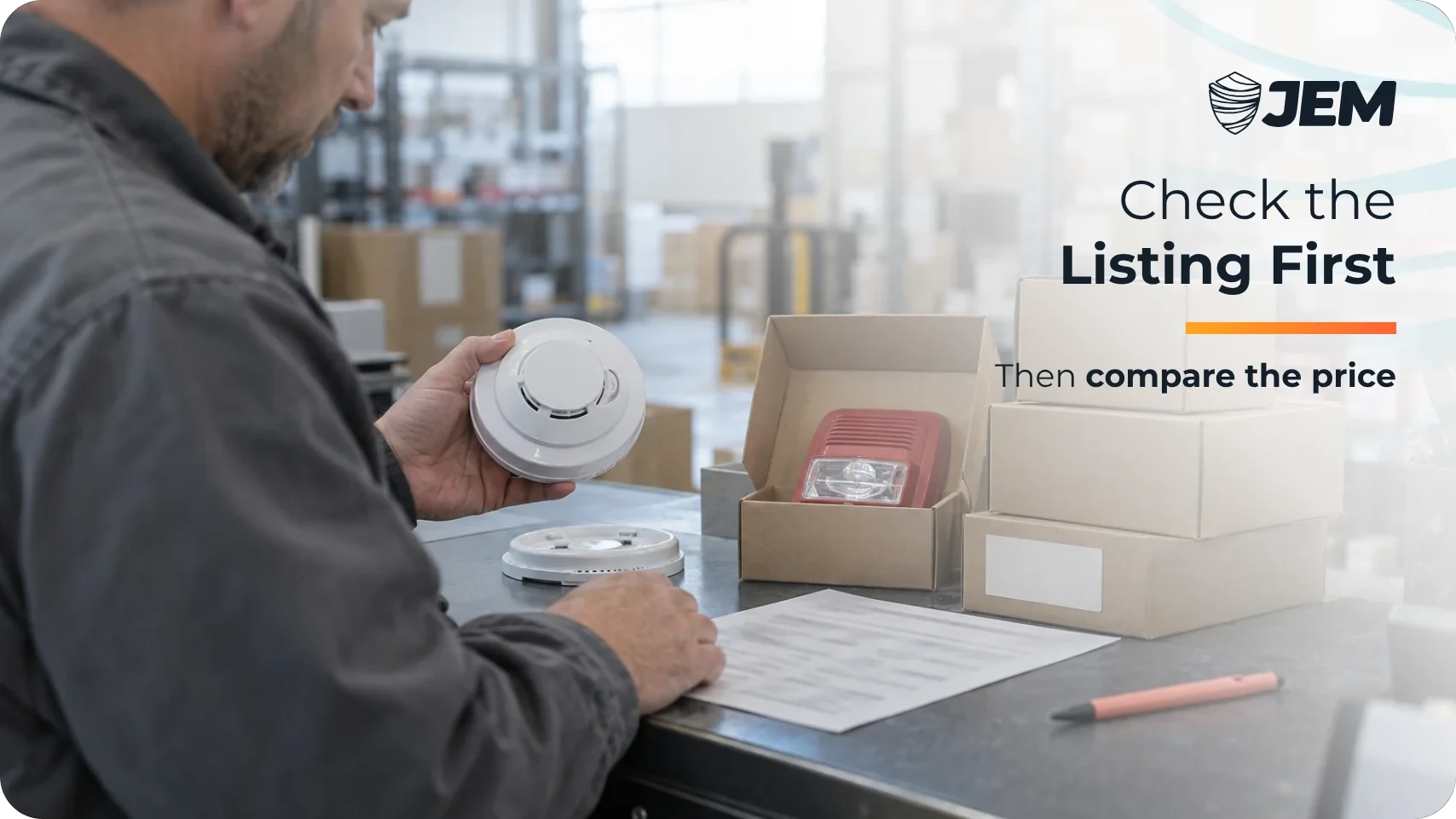
A good price on fire protection products only helps if the part passes the test and works with the rest of the system. A wrong detector, a missing listing or a late delivery can wipe out the savings fast. Below is a short checklist for buying fire alarm and detection parts, as of November 2026. It covers listings, panel fit, documents and timing.
Key takeaways
- Listing comes first: NFPA 72 calls for fire alarm equipment with a listing for its purpose.
- Panel fit is not optional: detectors and devices must work with the control unit, per the maker’s documents.
- Some states add rules: California, for example, has its own listing program and rules for replacement parts.
- Plan for cost and timing: prices and tariffs keep moving, so lock in what the job needs early.
Start with the listing
Under NFPA 72, equipment you build and install under the code needs a listing for the purpose it serves. That is the gist of how Wayne D. Moore quotes Section 10.3.1 of the 2025 edition in Electrical Contractor. The same article quotes 10.3.2, which ties installation, testing and maintenance to the maker’s published instructions.
So, before you compare prices on fire protection products, confirm the listing. One free way to check is UL Product iQ, the UL Solutions database of product listings.
Check compatibility before you buy fire protection products
However, a part can carry a listing and still be wrong for your panel. For example, many two-wire smoke detectors work only with the control units named in their listing. Honeywell’s Silent Knight device compatibility document lists compatible detectors by manufacturer, with limits per panel. It also warns not to mix different detector models on one zone, because false alarms could occur.
Also, compatibility does not always mean the same brand. As a UL column in IAEI Magazine explains, compatible devices are not limited to one manufacturer. Instead, the listed product’s installation instructions name them.
In practice, three habits help:
- Read the panel’s compatibility list before you order detectors.
- Match the submittal. Buy the model the AHJ approved, not a close cousin.
- Ask before you substitute. A swap may need a revised submittal.
Know your state’s rules
In addition, some states add their own layer. California is the best-known case. The Office of the State Fire Marshal runs the Building Materials Listing Program, which began as a way to require approval and listing of fire alarm systems and devices before sale or marketing in the state.
California also has rules for work on existing systems. For instance, the Division of the State Architect’s IR A-28 (rev. August 2024) says replacement devices must be CSFM listed and compatible with the existing control unit. That rule covers projects under DSA, so check how your own AHJ handles replacements.
Get the documents with your fire protection products
After all, paperwork is part of the product. Before a job, collect:
- Data sheets for every model on the submittal.
- Installation instructions, since NFPA 72 ties installation and testing to them.
- Compatibility documents for the panel and its devices.
- Listing proof, such as the UL or CSFM listing number, where the AHJ asks for it.
As a result, the final test goes faster, and the owner gets a clean set of records.
Plan for price and timing on fire protection products
Meanwhile, material costs have been moving. The Associated General Contractors of America reported that input costs for nonresidential construction rose 8.9% from August 2025 to August 2026. AGC also linked steep tariffs on key materials to rising prices and project delays.
For that reason, it pays to order early. Confirm stock before you commit to a date. Also, keep a short list of approved alternates.
What this means for contractors
A smart buy saves money twice: once on the bill and again at the final inspection. In practice:
- Confirm the listing and the compatibility list first.
- Buy to the submittal, and document any approved change.
- Collect documents with every order.
- Order early when prices and lead times are uncertain.
You can browse product lines by brand on JEM’s site and check specs on the JEM datasheet portal. JEM also offers same-day shipping for your projects.
Frequently asked questions
Does every fire alarm part need a listing?
NFPA 72 calls for a listing for its purpose on equipment you install under the code. Your AHJ decides how that applies on your job.
Can I mix detector brands on one panel?
Only if the device listings name that panel as compatible. Check the manufacturer’s compatibility document first.
Is a CSFM listing needed outside California?
CSFM is a California program. Other states and AHJs may have their own rules, so ask locally.
This article is general information and does not replace the requirements of your jurisdiction. Confirm the applicable codes with your AHJ.
Read next: Looking Back at NFPA 2025 with JEM Systems
Sources
- Fire Safety Q&A, Wayne D. Moore, Electrical Contractor (March 4, 2025)
- UL Product iQ, UL Solutions
- Silent Knight Device Compatibility Document, Honeywell (2025)
- Are Fire Alarms Listed as a System and Not Just Listed Components?, IAEI Magazine (July 2005)
- Building Materials Listing, California Office of the State Fire Marshal
- IR A-28, Fire Alarm System Changes in Existing Buildings, Division of the State Architect (rev. August 20, 2024)
- Construction input costs climb 8.9% between August 2025 and August 2026, AGC (September 10, 2026)
Leave a Reply