
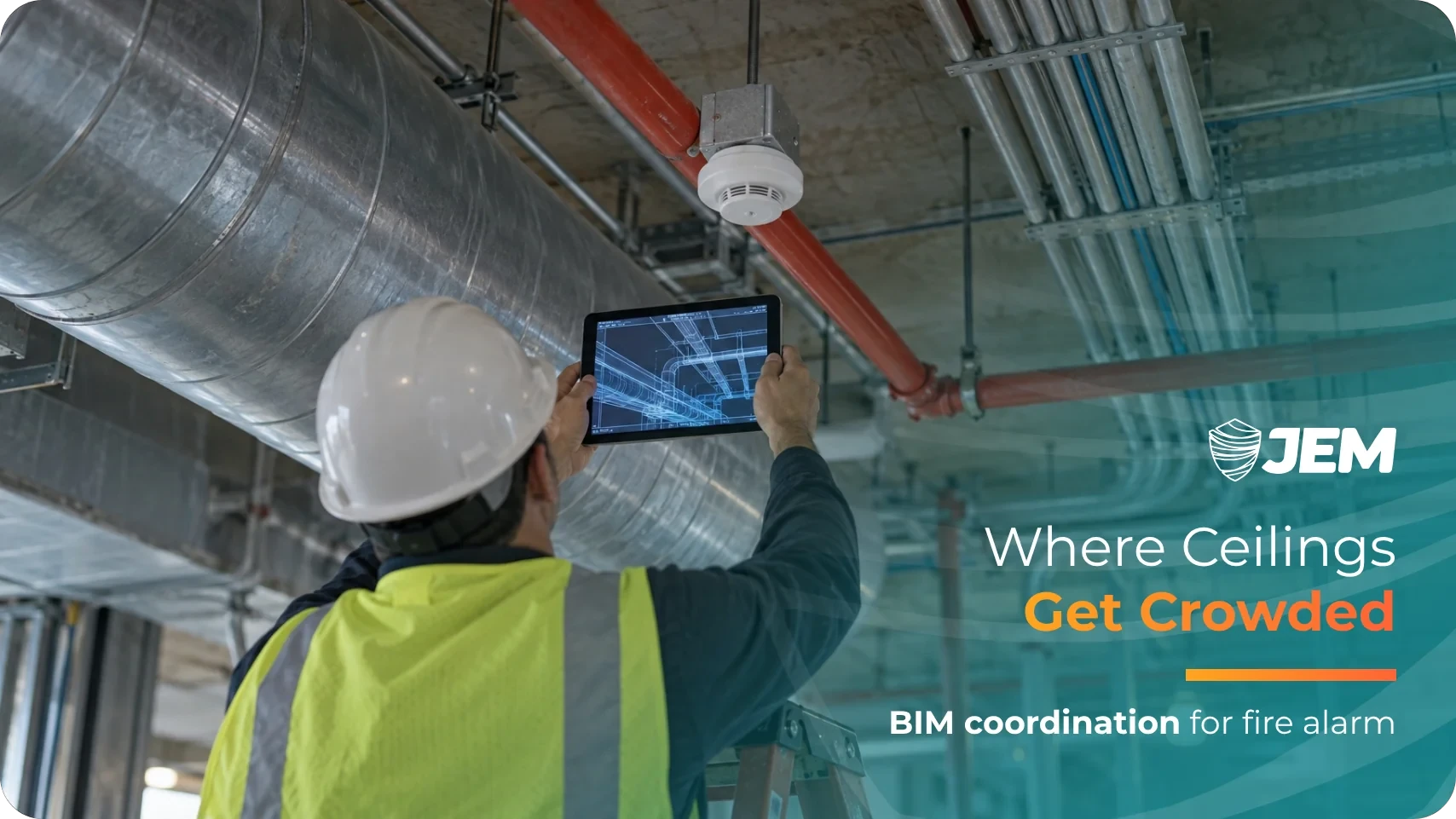
BIM is changing how fire and life safety systems get coordinated, but one term causes more confusion than any other: level of development. When a contract asks for a model at “LOD 300” or “LOD 350,” what does your team owe? This guide explains BIM LOD in plain terms, how it applies to fire alarm work, and which standards shape where BIM is heading, as of November 2026.
Key takeaways
- LOD sets how complete a model element is, from a generic symbol (LOD 100) to detail for fabrication and installation (LOD 400).
- The BIMForum LOD Specification is the common U.S. reference, with a 2025 edition.
- Fire alarm BIM has its own focus: device and conduit placement on crowded ceilings is where coordination pays off.
- Information management matters too: NBIMS-US and ISO 19650 shape how teams share model data.
What BIM LOD means
LOD stands for level of development. In short, BIM LOD describes how far you can rely on the model for a given element. The BIMForum LOD Specification is the main U.S. guide, and its latest edition is 2025. Its Part I uses these levels:
- Symbol (LOD 100): the element appears as a symbol or other generic representation.
- Generic object (LOD 200): approximate quantity, size and shape.
- As designed (LOD 300): defined quantity, size, shape, location and orientation.
- Interfaces (LOD 350): everything in LOD 300, plus links with nearby or dependent elements.
- Fabrication (LOD 400): detail for fabrication, assembly and installation.
Notably, the spec reproduces these definitions from AIA contract documents. So, the term often shows up in contracts, not just in design talks.
How BIM LOD applies to fire alarm work
For a fire alarm contractor, BIM LOD answers a practical question: how much will the model tell the field? For example:
- Early design (LOD 200): a smoke detector may be a generic object in about the right room.
- Final design (LOD 300): it sits at its designed location on the ceiling.
- Coordination (LOD 350): the model also shows how it relates to lights, diffusers, sprinklers and beams.
Clearly, that last step is where coordination happens. As Consulting-Specifying Engineer noted, BIM can help with coordinating the placement of devices on ceilings with other trades. However, the same article noted that BIM for fire alarm and detection was less common than for suppression systems.
Some clash tools now account for fire alarm needs. For instance, Trimble notes that clash detection can include the free space needed around fire detectors.
Questions to ask before you price BIM work
So, before you bid on a BIM job, get clear answers to a few questions:
- Which LOD applies to fire alarm devices, panels and conduit?
- Who owns which elements at each stage?
- What file format and software does the team use?
- How often will coordination meetings and clash runs happen?
After all, each answer changes your hours. As a result, a vague BIM clause can turn a profitable job into a loss.
The standards shaping the future of BIM
Still, BIM LOD is only one piece. In addition, two standards shape how teams manage model data.
First of all, the National BIM Standard-United States (NBIMS-US) is now in Version 4. Its terms page defines BIM as generating and using a shared digital representation of a built asset.
Secondly, ISO 19650-1 sets concepts and principles for information management across the whole life of a built asset. Notably, ISO lists it as under revision, so watch for a new edition.
Overall, these point to where BIM is heading: models that carry useful data from design through operation, not just 3D pictures.
What this means for contractors
In the end, BIM work rewards teams that read the contract closely. In practice:
- Confirm the LOD for every fire alarm element before you price.
- Coordinate devices early, where ceilings get crowded.
- Agree on formats and roles at kickoff.
- Keep the model current, since it may feed the owner’s records later.
Also, start small if BIM is new to your team. For example, model one floor of a pilot job at the required LOD, run a clash check and compare the hours to your estimate. Then, use that number to price the next job.
For modeling support, JEM’s BIM Modeling service covers fire alarm system and conduit modeling, plus clash coordination. For a broader view, read our article on the power of BIM in fire and life safety.
Frequently asked questions
What is the difference between LOD 300 and LOD 350?
LOD 350 adds the interfaces with nearby or dependent elements, which is what coordination needs.
Is LOD the same as level of detail?
Not quite. Instead, level of development describes how reliable the element’s information is, not only how detailed it looks.
Where can I find the LOD definitions?
In the BIMForum LOD Specification, which BIMForum offers for download on its site.
This article is general information and does not replace the requirements of your jurisdiction. Confirm the applicable codes with your AHJ.
Read next: Fire Alarm Training That Actually Drives Profit
Sources
- LOD Specification, BIMForum (2025 edition)
- LOD Specification 2025, Part I, BIMForum
- Coordinating fire protection designs via BIM, Consulting-Specifying Engineer (April 18, 2017)
- Clash detection in BIM projects, Trimble (February 7, 2024)
- National BIM Standard-United States, Version 4, NIBS
- NBIMS-US V4 Terms, NIBS
- ISO 19650-1:2018, ISO

Leave a Reply