
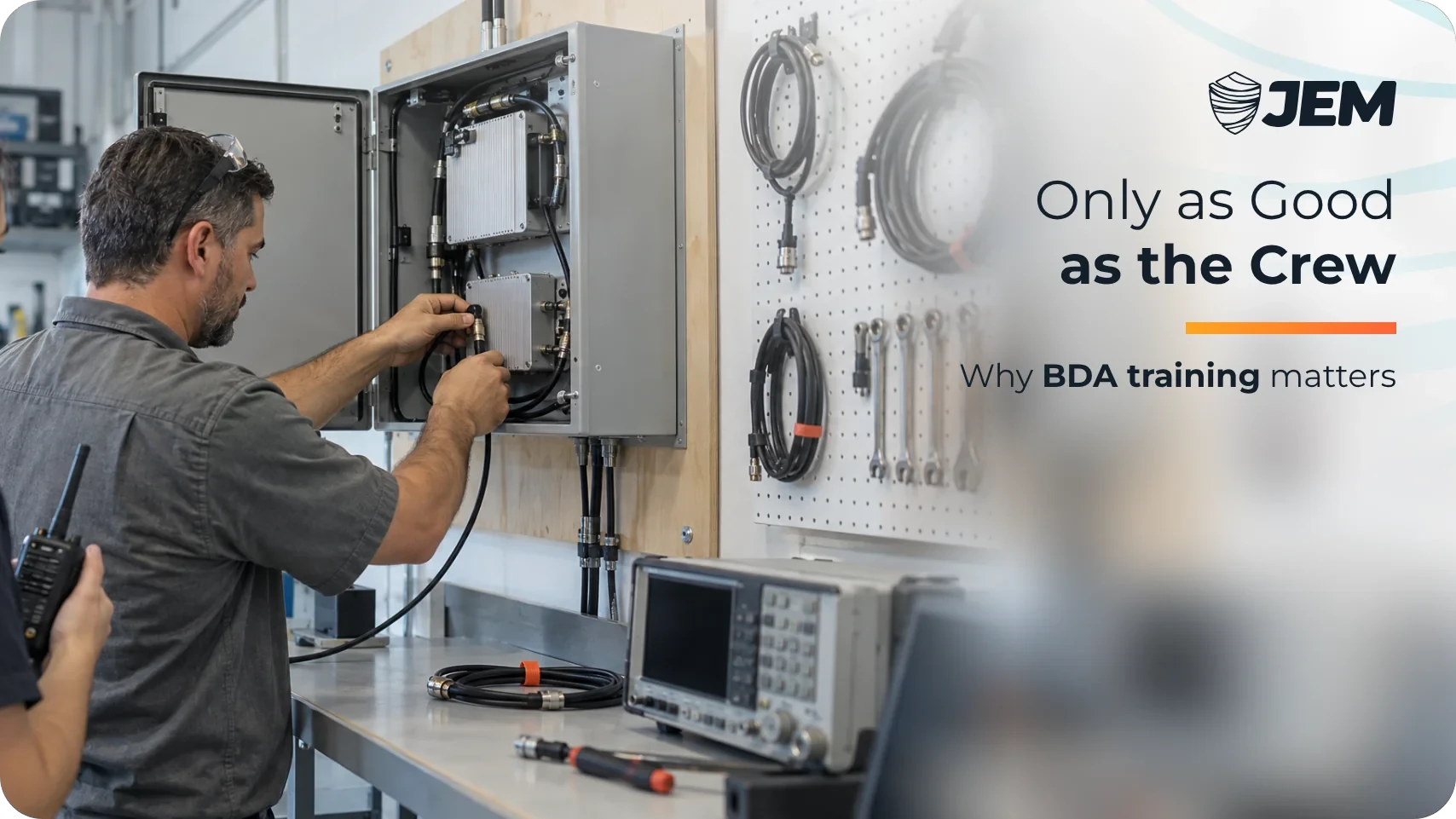
A bi-directional amplifier (BDA) only saves lives if it works on the day firefighters key their radios. So, it depends on the people who design, install, test and service it. That is why BDA training matters as much as the hardware. Below is what local rules ask of BDA crews, which credentials exist and how to plan training for the whole life of the system, as of November 2026.
Key takeaways
- People are part of the system: staff skills shape how well a BDA is put in and how well it runs.
- Some AHJs name credentials: examples include NICET levels, an FCC GROL or manufacturer certification for BDA/DAS/ERCES work.
- Training covers the full life cycle: installation, commissioning, testing and routine servicing.
- Plan it like a project: map roles, pick credentials and keep proof on file.
Why BDA training matters
First of all, a BDA system is not a set-and-forget device. Instead, it sits in a building that changes over time. Its job is to keep public safety radio working. As the International Fire & Safety Journal put it in February 2025, routine servicing is needed to maintain signal coverage and support reliable operation during emergencies.
In other words, a poorly trained crew can hurt a system long after the install. For example, a wrong setting, a missed alarm signal or a skipped test can leave a dead zone where firefighters need coverage most.
What local rules ask of BDA crews
There is no single national rule for who can work on BDA/DAS/ERCES. Instead, AHJs set their own. For instance, here are three examples:
- Durham, North Carolina: the city’s BDA/ERCES permit requirements ask for NICET Level II for technicians doing installations. For acceptance tests, they ask for NICET Level III plus an FCC GROL.
- Salt Lake City, Utah: the fire marshal’s ERCES policy (March 2025) accepts a GROL, NICET certification or certification from the system’s manufacturer for installers.
- California: the 2025 California Fire Code, Section 510.5.3, sets minimum qualifications for ERCES design and installation staff, as our ERCES codes article explains.
So, before you staff a job, check what your AHJ asks for. After all, rules can differ from one city to the next.
Credentials for BDA training
In practice, three kinds of credentials come up most often.
NICET IBPSC
NICET’s In-Building Public Safety Communications program has a three-level technician track and a one-level design track, according to NICET. As a result, it gives crews a clear path from entry level to testing roles.
FCC GROL
Meanwhile, the FCC General Radio Operator License shows up in several local rules, for roles from installation to acceptance testing. For that reason, it makes sense to have at least one licensed person on teams that do this work.
Manufacturer certification
Finally, many BDAs come with factory training. Typically, it teaches the setup, alarm outputs and service steps for that product. Also, some AHJs accept it as proof of skill.
Build a BDA training plan
A good plan covers the whole life of the system, not just the install. So, here is a simple way to set it up:
- List the roles: designer, installer, commissioning tech and service tech.
- Match each role to a credential your AHJs accept.
- Train on the products you sell, with hands-on time on real equipment.
- Practice testing, since commissioning is where many jobs stall.
- Keep proof on file, so you can show it with the submittal.
Hands-on events also help. For example, JEM hosted a BDA Training Week in Phoenix in early 2025, which prepared attendees for NICET IB-PSC Levels 1 and 2. Then, in October 2026, a training week in Duluth, Georgia, brought in Fiplex by Honeywell and PCTEL sessions.
What this means for contractors
In short, BDA training is not a one-time cost. Rather, it is how you keep systems working and jobs moving. In practice:
- Check local rules before you bid.
- Plan credentials per role, not per person.
- Refresh skills when products or codes change.
- Document everything for the AHJ and the owner.
In turn, a trained crew passes acceptance tests sooner, fixes faults faster and gives owners more trust in the system. That trust can also help you win the service work after the install.
For help with certifications, JEM’s BDA Design team assists teams in securing manufacturer certifications. To find upcoming sessions, check the JEM Events Hub.
Frequently asked questions
Is NICET required for BDA work?
Not everywhere. Some AHJs, like Durham, North Carolina, name NICET levels. Others accept a GROL or manufacturer certification. Check locally.
What is the IBPSC certification?
It is NICET’s In-Building Public Safety Communications program, with technician and design tracks.
How often should BDA crews train?
There is no single rule. A good habit is to train when you add a new product, a new AHJ or a new role.
This article is general information and does not replace the requirements of your jurisdiction. Confirm the applicable codes with your AHJ.
Read next: Scaling Your Fire & Life Safety Business: 5 Practical Levers
Sources
- JEM Systems BDA training, International Fire & Safety Journal (February 21, 2025)
- Permit Requirements for BDA/ERCES Systems, City of Durham, NC
- ERCES Policy, Salt Lake City Fire Marshal (March 2025)
- 2025 California Fire Code, Section 510 (reading copy), GoCodebook
- IBPSC, NICET newsletter (Fall 2022)
Leave a Reply